Insiders #5 with Umanium: Why Companies Get Mexico Wrong
Jorge Thomas, Co-Founder of Umanium, on building a Mexico-only EOR through the 2021 outsourcing reform, the US and Canada nearshoring wave, the Chinese manufacturing boom, and why severance economics are the single largest hidden cost foreign employers miss when hiring in Mexico.

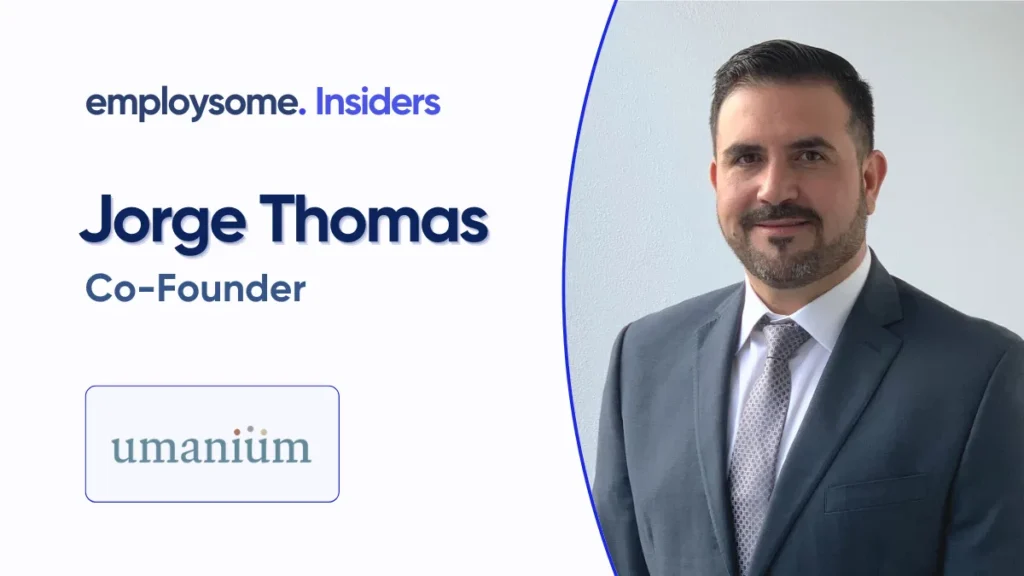
Welcome to Employsome Insiders, a series where we sit down with Employer of Record (EOR) founders and operators to dig into the markets, models, and decisions behind the companies shaping global employment. Honest conversations with the people building this industry from the ground up. For this edition, we spoke with Jorge Thomas, Co-Founder of Umanium.
While most global platforms list Mexico as one of 150+ available countries, Umanium runs the opposite play: pick one market, go deep on local labor law, and let the operational depth become the moat. The business has been built through Mexico’s 2021 outsourcing reform, the rise of US and Canada nearshoring, and a wave of Chinese manufacturing investment that has reshaped the country’s industrial base. Umanium’s positioning is local-first by design: REPSE-registered, IMSS-fluent, and run by a team that handles severance calculations as a core capability rather than an edge case.

From 2021 Outsourcing Reform to Specialized Services
Mexico’s 2021 outsourcing reform sharply restricted how companies can engage workers through third parties and forced every provider in the market to rebuild around the new framework. We asked Jorge how it reshaped Umanium’s business and how it shapes the way EOR arrangements are structured today.
“The 2021 reform significantly increased the regulation of outsourced personnel services for companies established in Mexico. Instead of resisting the changes or complaining about the new system, we adjusted our structure and processes to move with the current rather than against it.
First, in order to guarantee compliance for our clients, we had to fully adapt to the new regulations and obtain the required REPSE registrations for our corporate structure. This registration, issued by the Mexican Ministry of Labor, is mandatory in order to legally provide Specialized Services and Specialized Works. The term ‘specialized’ can sound confusing, but in practice it is simply the legal framework now used to regulate outsourcing and third-party personnel services in Mexico.
Second, as the domestic market contracted after the reform, we decided to focus more aggressively on the international market. Although we had already worked with foreign clients for many years, our primary market had historically been local Mexican companies. Today, most of our clients are based abroad.”
Jorge Thomas, Co-Founder of Umanium
The REPSE registration is the operational gating fact for any provider operating in Mexico. Without it, a provider cannot legally place workers with a client company under a specialized services arrangement, and any client engaging an unregistered provider faces tax deductibility issues and labor exposure. The reform effectively shrunk the supply side of the Mexican outsourcing market, which created a natural opening for compliant specialists to take share from non-compliant local operators and to position against global platforms that handled Mexico as one more box to tick.
Nearshoring as Operational Reality, Not Just Narrative
Mexico has been positioned as the nearshoring destination for North American supply chains for the last three years, but the narrative often runs ahead of the operating numbers. We asked Jorge whether the demand he sees on the ground actually matches the headline story.
“Mexico definitely remains an ideal nearshoring destination for US and Canadian companies. We have geographic proximity, aligned time zones, strong logistics infrastructure, highly skilled talent, and a free trade agreement that also makes Mexico attractive for corporations from other countries seeking access to the North American market while complying with rules of origin requirements.
Mexico has positioned itself as the United States’ top trading partner, surpassing both Canada and China. Bilateral trade operations reached a new record of USD 873 billion in 2025, despite tariffs remaining a constant topic in the political agenda. Official figures also show that in 2025 the United States remained Mexico’s largest foreign investor, representing 38.8% of total foreign investment, while Canada represented 8%.
But more importantly, in day-to-day operations we clearly see continuous growth in the hiring of workers in Mexico by companies from both countries, for both on-site and remote work positions. We are witnessing foreign companies hiring talent in Mexico for highly technical roles such as engineering design and project supervision, as well as creative roles in design and digital marketing, in addition to software development, administration, business development, and customer service positions.”
Jorge Thomas, Co-Founder of Umanium
The distinction between the trade narrative and the operating reality matters because EOR demand is driven by individual hiring decisions, not by macro flows. Trade dollars can move through reshored factories that employ Mexican workers directly on the manufacturer’s payroll. EOR demand grows when foreign companies hire individual specialists, designers, developers, and project managers in Mexico without setting up a local entity. Jorge’s observation that hiring is spreading across technical, creative, and operational roles suggests the demand is broader than a pure manufacturing reshoring story.
A Mexico EOR With a China Office
Umanium opened a representative office in China, which is an unusual move for a country-specialist EOR. We asked Jorge why, and what kind of demand he is seeing from Chinese companies hiring in Mexico.
“It is no secret that Chinese corporations are expanding aggressively around the world, and Mexico is no exception. The automotive industry is a very visible example of this trend. Starting in 2023, Mexico experienced a massive arrival of automotive distributors representing more than 20 Chinese car brands, including BYD, GWM, Chirey, and Omoda.
Practically overnight, Chinese automotive companies opened more than 500 dealerships across Mexico. Their expansion was so aggressive that by the end of 2025, it is estimated that 15 out of every 100 vehicles sold in Mexico were already of Chinese origin. From zero to 15% market share in the blink of an eye.
Beyond the automotive boom, Chinese companies have continued investing heavily in manufacturing and auto parts production. This type of investment and operational rollout often relies on EOR services during the early stages in order to begin operations immediately. Having a representative office in China has helped us maintain a presence in that market.”
Jorge Thomas, Co-Founder of Umanium
This is a sharp commercial bet. Chinese manufacturers entering Mexico face the same operational gap that US and Canadian companies face but compounded by language, time zone, and cultural distance. The early-stage Chinese entrant often needs to hire local distribution, after-sales service, regulatory affairs, and administrative staff months before any local entity is operational. A China-based business development presence helps Umanium be the default option at the moment the decision is made, which in operationally complex markets is often the moment that locks in the provider relationship.
💡 Employsome Insight
EOR demand and trade volume are not the same signal. Headline trade figures between the US and Mexico are dominated by goods moving through reshored factories, where workers are usually direct hires of the manufacturer. EOR demand tracks something different: knowledge workers, software developers, and creative specialists hired remotely by companies with no Mexican legal presence. The 38.8% US share of foreign investment is a useful proxy, but the more granular signal worth watching is job posting volume on Mexican LinkedIn from companies with no local entity. For the broader market picture, read our EOR market size and trends analysis.
The Severance Trap and Other Hidden Costs
Foreign companies hiring in Mexico for the first time consistently underestimate the compliance load. We asked Jorge which obligation produces the most friction, and what it tends to cost employers who get it wrong.
“Without question, the least understood, most underestimated, and often most disliked cost is mandatory severance when terminating an employee or ending an indefinite-term employment relationship. It does not matter whether the employee worked for one day or twenty years.
In many countries, an employer simply provides notice, pays the final paycheck, and the relationship ends. In Mexico, it does not work that way. Employees are entitled not only to their accrued benefits, but also to severance compensation equal to 90 days of salary plus 12 days of seniority premium per year of service. In practical terms, employers should expect a termination cost equivalent to roughly 3.5 months of salary.
Although Mexican law does contemplate justified termination scenarios that may exempt the employer from paying severance, the employer must present strong and verifiable evidence within a formal labor proceeding. Labor litigation can become so expensive and time-consuming that most employers choose to negotiate a settlement through the labor conciliation courts offered by the authorities themselves.
To avoid surprises, we always include a sample severance calculation for an employee with one year of service as part of our quotation process. This gives clients a clear understanding of the obligation and its financial impact from the very beginning.”
Jorge Thomas, Co-Founder of Umanium
Most cost comparisons that buyers run when evaluating Mexico against alternatives focus on monthly salary plus IMSS load plus aguinaldo, and stop there. The severance liability is treated as a low-probability event and excluded from the comparison. That is the wrong frame. Even a one-year hire that ends in a no-fault termination carries roughly 3.5 months of severance, which adds 25 to 30 percent to the true all-in cost of the engagement. For broader cost benchmarks across markets, see our EOR cost guide.
Where Global Platforms Fall Short Locally
Global EOR providers like Deel, Remote, and G-P all list Mexico as a covered country. We asked Jorge, as a Mexico-only specialist, where he sees the biggest gap between what global platforms offer and what companies actually need when hiring locally.
“I prefer not to refer to specific companies or brands, but it is an interesting topic to discuss in general terms.
Large global providers clearly dominate in terms of technology, but at the same time that can become their biggest weakness. The platforms are impressive until a real issue arises locally. When that happens, the limitations become obvious. They operate Mexico as one more country within a catalog of 150 destinations. Listing Mexico as an available country is not the same as truly understanding Mexico.
Our market research identified recurring complaints among their own clients: inflated cost structures, high and non-transparent fees, slow responses with very limited human interaction, constant account manager turnover, operational rigidity, billing mistakes, payroll delays, lack of understanding of local labor law, and even system bugs.
A strong local EOR does not compete only on technology. The real advantage is genuine local knowledge and experience. Someone who understands the law, calculates correctly, and answers the phone when you need support. That is where a specialist makes the difference: deep knowledge of Mexican labor regulations, transparent pricing, and a local team that solves problems instead of escalating tickets.
There is also another side of the business that many large EOR providers underestimate, but which for us is just as important as the client: the employee. Large providers often focus primarily on the client, billing, and revenue generation, but they rarely focus on designing compensation structures that help employees maximize their net income. Some platforms even charge employees fees to access or withdraw their payroll funds, a practice considered illegal in Mexico.
Our service philosophy is simple: payroll must always be paid fully and on time, no matter what. Employees and their families depend on receiving their compensation as expected in order to meet their personal obligations and daily needs. Companies that truly understand this industry know they do not simply need an administrative intermediary. They need a partner genuinely committed to full compliance, including ensuring that employees feel comfortable and confident being hired through a reliable Employer of Record structure.”
Jorge Thomas, Co-Founder of Umanium
💡 Employsome Insight
The specialist versus platform trade-off cuts both ways. Country specialists genuinely outperform global platforms on local labor law nuance, severance modeling, and human responsiveness in their home market. Where they tend to underperform is multi-country consolidation, platform reporting, and the buyer experience of a company hiring across five jurisdictions who wants one invoice and one dashboard. The right answer is rarely one or the other. For a single-country Mexico hire with operational complexity, a specialist usually wins. For a 15-country rollout where Mexico is one piece, a global platform with verified local Mexican delivery capability often wins on operational simplicity. The decision is driven by the number of countries, the complexity per country, and the buyer’s tolerance for managing multiple vendor relationships.
PTU, the Other Mexico-Specific Annual Surprise
Profit sharing (PTU), IMSS contributions, aguinaldo, and the REPSE permit all sit on the Mexico compliance stack alongside severance. We asked Jorge which of these creates the most friction after severance, and how Umanium handles it.
“The other issue that inevitably comes up every year is PTU, Mexico’s mandatory profit-sharing obligation, which employers must comply with before May 30 each year. In simple terms, companies must distribute 10% of their declared taxable profits from the previous fiscal year among eligible employees.
How do we handle it? First, we proactively provide information to clients beginning in April and answer their questions. Second, we suggest that regardless of the amount legally required, companies may voluntarily choose to add an additional bonus during that period in whatever amount they prefer. This practice tends to generate a very positive impact on employer branding, employee loyalty, and retention.”
Jorge Thomas, Co-Founder of Umanium
The PTU obligation is structurally awkward for foreign companies. In an EOR arrangement, the 10% is calculated on the provider’s taxable profits attributable to the client engagement, which means the bill the client receives can feel decoupled from their own profitability. Different providers handle the pass-through differently. The transparent ones disclose the calculation methodology during the quotation process and surface the obligation in April so clients can budget. The less transparent ones bury it in a generic compliance fee and surprise the client in May.
Where Mexico’s EOR Market Is Heading
We asked Jorge whether he expects more Mexican specialists to emerge over the next few years, or whether the global platforms will dominate.
“More Mexican Employer of Record providers are definitely emerging, and some are already beginning to expand into foreign markets, particularly in Central and South America. As technology becomes more accessible and widespread, Mexican EOR providers that choose to do so will increasingly be able to develop stronger tools and move toward a more high-tech operational model.
Large global platforms are clearly built for scale and mass-market operations. They will likely continue attracting significant volumes and maintaining strong market share. However, for larger or more complex projects requiring real consulting expertise and strategic compensation engineering, local specialists will continue to be the stronger alternative.”
Jorge Thomas, Co-Founder of Umanium
The interesting structural observation is that Mexican specialists are starting to export, not the other way around. A Mexico-built EOR with infrastructure for severance modeling, REPSE compliance, and IMSS contribution management is well-positioned to expand into Colombia, Costa Rica, Chile, and Argentina, where the labor law DNA shares a lot with Mexico’s. This is roughly the same regional expansion route Wide is running from Brazil into Spanish-speaking LatAm, and it suggests the next 24 months will produce a generation of regional LatAm specialists positioned somewhere between country-pure plays and global platforms.
One Piece of Advice
“Although we have always worked with foreign clients, most of those opportunities came through referrals rather than active international business development. My advice to myself would have been simple: pay attention to the international market. There is an enormous opportunity there that very few companies in Mexico are truly pursuing. Something as simple as understanding the meaning and relevance of the term ‘EOR’ earlier would have helped us better position our digital communication strategy to attract clients from other countries.”
Jorge Thomas, Co-Founder of Umanium
This is the fifth edition of Employsome Insiders. If you’re building in the EOR space and want to be featured, get in touch.
Want to compare EOR providers including Umanium side by side? Start comparing on Employsome, it’s free.
Written by
Christa is a Copywriter at Employsome with 17 years of professional writing experience across global brands, startups, and online publications. A native English-Finnish writer, she brings strong editorial skills and a versatile background in business, SaaS, and finance. At Employsome, Christa focuses on clear, practical content about HR, payroll, and Employer of Record topics.
Our content is created for informational purposes only and is not intended to provide any legal, tax, accounting, or financial advice. Please obtain separate advice from industry-specific professionals who may better understand your business’s needs. Read our Editorial Guidelines for further information on how our content is created.
Other posts
Read More Insiders