Minimum Wage in Malaysia: The Complete 2026 Guide
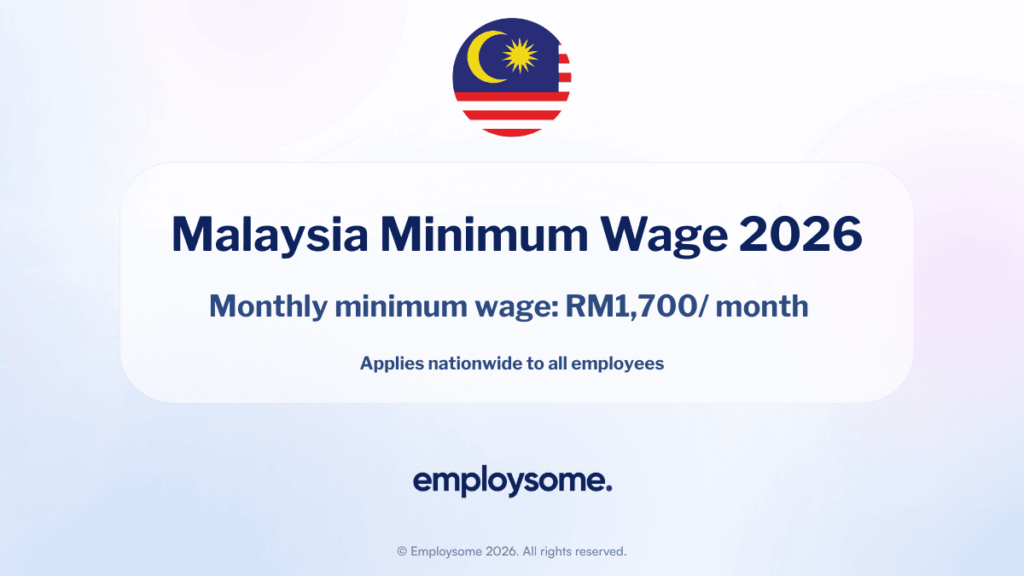
Malaysia’s minimum wage in 2026 is RM1,700 per month (approximately USD 370), unchanged from the increase that took effect on 1 February 2025. The rate applies nationwide to all employees, including foreign workers, part-time workers, and gig workers. The only exemptions are domestic helpers and apprentices. This guide covers the current minimum wage rates in Malaysia, daily and hourly breakdowns, mandatory employer contributions (EPF, SOCSO, EIS), working hours and overtime rules, leave entitlements, penalties for non-compliance, and what international companies hiring in Malaysia need to know.


Minimum Wage in Malaysia: Current Rates
The minimum wage in Malaysia is set under the Minimum Wages Order 2024, governed by the National Wages Consultative Council Act 2011 (Act 732). The current rate of RM1,700 per month took effect on 1 February 2025 for employers with five or more employees and those in professional services (classified under MASCO), and on 1 August 2025 for all remaining employers, including micro-enterprises with fewer than five employees. As of 2026, the rate applies universally to all non-exempt employers nationwide.
The minimum wage in Malaysia refers strictly to basic pay. Allowances, bonuses, commissions, overtime payments, and benefits in kind cannot be included in the minimum wage calculation. An employee earning RM1,500 in basic pay plus RM200 in transport allowance is not compliant; the basic wage itself must be at least RM1,700.
Monthly, Daily, and Hourly Rates
|
Measure |
Rate |
Notes |
|
Monthly |
RM1,700 |
National rate, all regions |
|
Hourly |
RM8.72 |
Based on 48-hour maximum week |
|
Daily (6-day week) |
RM65.38 |
RM1,700 ÷ 26 days |
|
Daily (5-day week) |
RM78.46 |
RM1,700 ÷ 21.67 days |
|
Daily (4-day week) |
RM98.08 |
RM1,700 ÷ 17.33 days |
Daily rates vary depending on the number of working days per week because the monthly minimum remains fixed at RM1,700 regardless of the employee’s schedule. Part-time employees must also receive at least RM8.72 per hour.
 Employsome Insight: Malaysia’s Minimum Wage Is a National Flat Rate
Unlike some countries that set different minimum wage levels by region, industry, or city size, Malaysia has applied a single national minimum wage since 2022. Previously, there were separate rates for Peninsular Malaysia and for Sabah, Sarawak, and Labuan. The current RM1,700 rate applies identically in Kuala Lumpur, Penang, Johor Bahru, Kota Kinabalu, and rural areas. International companies do not need to track regional rate differences when hiring across Malaysian states.
Who the Minimum Wage Applies To
The minimum wage in Malaysia applies broadly:
- All full-time, part-time, and contract workers under a contract of service
- All local and foreign workers (including those on valid work permits)
- Workers on probation
- Employees paid by piece rate, tonnage, task, trip, or commission — their total monthly earnings must still meet RM1,700
- Gig workers classified under a contract of service
Exemptions
The following categories are exempt from the minimum wage:
- Domestic helpers (maids, personal drivers, gardeners) — though the government has indicated future reviews on domestic worker wages
- Apprentices under formal training or education-linked programmes
- Interns not under a formal employment contract
The minimum wage applies equally to Malaysian citizens and foreign nationals. There is no separate minimum wage for foreign workers. This aligns with the ILO’s Equal Remuneration Convention, which Malaysia observes.
Mandatory Employer Contributions
In addition to the minimum wage, employers in Malaysia must make several mandatory statutory contributions. These significantly increase the total cost of employment beyond the gross salary figure.
Employees Provident Fund (EPF / KWSP)
EPF is Malaysia’s compulsory retirement savings scheme. Both employer and employee contribute monthly based on the employee’s wages. Employer contribution rates are:
- 13% of monthly wages for employees earning RM5,000 or less
- 12% of monthly wages for employees earning more than RM5,000
- Employee contribution: 11% of monthly wages (deducted from salary)
- Age 60+: Employer rate reduces to 4%; employee contribution becomes optional (0%)
EPF contributions must be remitted by the 15th of the following month. Late payments incur interest penalties of 6% per annum, with a minimum charge of RM10. Criminal penalties can include fines up to RM10,000 or imprisonment up to 3 years.
For a minimum wage employee earning RM1,700 per month, the employer’s EPF contribution is RM221 per month (13%). The employee’s deduction is RM187 (11%).
Social Security Organisation (SOCSO / PERKESO)
SOCSO provides protection against workplace injuries, occupational diseases, and invalidity. Contributions are based on a tiered schedule depending on the employee’s wage bracket, capped at a monthly salary of RM6,000. The employer’s share is approximately 1.75% of the employee’s salary, while the employee contributes approximately 0.5%. SOCSO contributions are submitted alongside EIS contributions by the 15th of the following month.
For a minimum wage employee, the employer’s SOCSO contribution is approximately RM29.75 per month.
Employment Insurance System (EIS / SIP)
EIS provides short-term financial assistance and re-employment support to employees who lose their jobs through retrenchment. Both employer and employee contribute equally at 0.2% of monthly wages, capped at a monthly salary ceiling of RM5,000 (increased from RM4,000 in October 2024). Contributions are submitted together with SOCSO.
For a minimum wage employee, the employer’s EIS contribution is approximately RM3.40 per month.
Human Resources Development Fund (HRDF)
Employers in specified industries (including manufacturing, services, and mining) with 10 or more employees must contribute 1% of monthly payroll to the HRDF for employee training and development. Employers with 5–9 employees may register voluntarily. HRDF is often overlooked by international companies expanding into Malaysia but is enforceable and audited.
Total Employer Cost Summary
|
Component |
Amount (RM1,700 base) |
|
Gross salary |
RM1,700.00 |
|
EPF employer (13%) |
RM221.00 |
|
SOCSO employer (~1.75%) |
~RM29.75 |
|
EIS employer (0.2%) |
~RM3.40 |
|
HRDF (1%, if applicable) |
RM17.00 |
|
Total employer cost |
~RM1,971 per month |
Employers should budget approximately 15–20% above gross salary for mandatory statutory contributions when hiring in Malaysia. This makes the total employer cost for a minimum wage employee approximately RM1,950–RM1,970 per month before any optional benefits.
Employsome Insight: EPF Is the Largest Employer Cost in Malaysia
Unlike many Southeast Asian countries where social security is the dominant payroll cost, Malaysia’s EPF retirement savings scheme is by far the largest mandatory contribution at 12–13% of gross wages. This is comparable to Singapore’s CPF (17% employer share) but significantly higher than Thailand’s social security (5%) or Indonesia’s combined BPJS schemes. International companies should factor EPF into their total compensation modelling from the outset, particularly for roles close to the RM5,000 threshold where the employer rate drops from 13% to 12%.
Working Hours and Overtime
Working hours in Malaysia are governed by the Employment Act 1955, as amended in 2022 (effective 1 January 2023). Key rules:
- Maximum regular working hours: 8 hours per day, 45 hours per week (reduced from 48 hours in the 2022 amendment)
- Maximum total hours (including overtime): 12 hours per day
- Maximum overtime: 104 hours per month
- Mandatory rest break: At least 30 minutes after every 5 consecutive hours of work
- Rest day: Minimum 1 rest day per week
Overtime Rates
Overtime entitlements apply to employees earning RM4,000 per month or less (except manual workers, who are entitled regardless of salary). Overtime rates based on the minimum hourly rate of RM8.72:
|
Overtime Type |
Rate |
|
Normal working day (beyond 8 hrs) |
1.5× hourly rate (RM13.08/hr) |
|
Rest day (normal hours) |
2.0× hourly rate (RM17.44/hr) |
|
Rest day (beyond normal hours) |
2.0× hourly rate |
|
Public holiday (normal hours) |
2 days’ wages + holiday pay (3 days’ total) |
|
Public holiday (beyond normal hours) |
3.0× hourly rate (RM26.16/hr) |
Employees earning above RM4,000 per month (except manual workers) are exempt from statutory overtime entitlements. However, public holiday pay protections apply to all employees regardless of salary level.
Leave Entitlements in Malaysia
The Employment Act 1955 establishes minimum leave entitlements for all employees in Malaysia:
Annual Leave
|
Length of Service |
Minimum Annual Leave |
|
Less than 2 years |
8 days |
|
2 to 5 years |
12 days |
|
More than 5 years |
16 days |
Sick Leave
|
Length of Service |
Minimum Paid Sick Leave |
|
Less than 2 years |
14 days |
|
2 to 5 years |
18 days |
|
More than 5 years |
22 days |
If hospitalisation is required, employees are entitled to an additional 60 days of hospitalisation leave per year.
Other Leave
- Maternity leave: 98 consecutive days (paid, for female employees who have been employed for at least 90 days in the 9 months before confinement)
- Paternity leave: 7 consecutive days (paid, introduced in the 2022 amendment)
- Public holidays: 11 paid public holidays per year, of which 5 are mandatory (Labour Day, Yang di-Pertuan Agong’s Birthday, National Day, Malaysia Day, and State Ruler’s Birthday / Federal Territory Day)
Employsome Insight: Malaysia’s Leave Entitlements Are Modest by Global Standards
Malaysia’s minimum annual leave of 8 days for new employees is lower than most European countries (where 20–25 days is standard) and lower than several ASEAN neighbours. International companies offering only the statutory minimum may find it difficult to attract talent, particularly in competitive sectors like tech, finance, and shared services. Most competitive employers in Malaysia offer 14–18 days of annual leave from the start, plus additional medical and hospitalisation coverage beyond the statutory minimum.
Penalties for Non-Compliance
Employers who fail to comply with minimum wage regulations face significant penalties under the National Wages Consultative Council Act 2011:
- First offence: Fine of up to RM10,000 for each employee not paid the minimum wage
- Continuing offence: Additional fine of up to RM1,000 per day for each day the offence continues after conviction
- Repeated offences: Fine of up to RM20,000 or imprisonment for up to 5 years
In addition, the court may order the employer to pay the wage difference to affected employees. Employees can file complaints directly with the Department of Labour Malaysia (JTKSM), which conducts inspections and investigations into non-compliant businesses.
Statutory contribution penalties are enforced separately: EPF late payments incur 6% annual interest; SOCSO late payments also attract 6% annual interest calculated daily; and late PCB (monthly tax deduction) remittance can result in penalties from 10% to 100% of the tax owed by the Inland Revenue Board (LHDN).
Minimum Wage History in Malaysia
Malaysia first introduced a national minimum wage in 2013 under the Minimum Wages Order 2012. The rate has been revised several times since:
|
Year |
Monthly Rate |
Notes |
|
2013 |
RM900 (Peninsular) / RM800 (Sabah, Sarawak) |
First national minimum wage |
|
2016 |
RM1,000 / RM920 |
Regional rates retained |
|
2019 |
RM1,100 (nationwide) |
First uniform national rate |
|
2020 |
RM1,200 (57 city/municipal areas) |
Higher rate for urban areas |
|
2022 |
RM1,500 (nationwide) |
Single national rate restored |
|
2025 |
RM1,700 (nationwide) |
13% increase, phased rollout |
The minimum wage has increased approximately 90% since its introduction in 2013, from RM900 to RM1,700. The government typically reviews the minimum wage every two years through the National Wages Consultative Council, considering factors such as inflation, cost of living, labour productivity, and economic conditions. The next review is expected by 2027.
Malaysia vs. ASEAN: Minimum Wage Comparison
How does Malaysia’s minimum wage compare to its Southeast Asian neighbours?
|
Country |
Monthly Minimum Wage (approx.) |
Employer Payroll Burden |
|
Malaysia |
RM1,700 (~USD 370) |
~15–20% (EPF, SOCSO, EIS) |
|
Thailand |
~THB 10,140–12,000 (~USD 290–340) |
~5% (social security) |
|
Indonesia (Jakarta) |
~IDR 5.4m (~USD 335) |
~20%+ (BPJS combined) |
|
Philippines (NCR) |
~PHP 14,040 (~USD 245) |
~10–12% (SSS, PhilHealth, Pag-IBIG) |
|
Vietnam (Region I) |
~VND 4.96m (~USD 195) |
~21.5% (social, health, unemployment) |
|
Singapore |
No national minimum wage |
~17% (CPF) |
Malaysia sits in the middle of the ASEAN range in absolute terms but has a relatively high employer payroll burden due to the EPF retirement savings contribution. Total employer cost for a minimum wage employee is comparable to Indonesia but higher than Thailand or the Philippines.
Employsome Insight: Malaysia Offers Strong Infrastructure for Its Wage Level
While Malaysia’s minimum wage is higher than Thailand, Vietnam, or the Philippines, the country offers advantages that often justify the premium: a highly multilingual workforce (English, Malay, Mandarin, Tamil), well-developed digital infrastructure, a stable regulatory environment, and strong IP protections under common law. For international companies building shared services centres, customer support hubs, or tech operations in Southeast Asia, Malaysia often provides the best balance of cost, talent quality, and operational ease. An EOR in Malaysia can handle all statutory contributions, payroll compliance, and employment contracts without requiring a local entity.
What International Companies Need to Know
For companies based outside Malaysia that want to hire Malaysian workers, several practical considerations apply:
- The minimum wage applies to all workers, including foreign nationals. There is no separate rate for expatriates or foreign workers in covered roles.
- Wages must be paid in Malaysian Ringgit (RM). The Employment Act requires payment in legal tender, typically via bank transfer. Employers must pay wages no later than the 7th day after the end of the wage period.
- Basic wage must meet RM1,700 before any add-ons. Allowances, commissions, bonuses, and benefits cannot be used to reach the minimum wage threshold. The basic salary line on the payslip must show RM1,700 or more.
- EPF registration is mandatory. Employers must register with EPF within 7 days of hiring their first employee. SOCSO and EIS registration must be completed within 30 days.
- Foreign worker EPF: EPF contributions for foreign workers were historically voluntary. The government announced mandatory EPF for foreign workers starting October 2025 — international employers should verify current requirements as implementation details continue to evolve.
- Employment Pass salary thresholds are separate from the minimum wage. From June 2026, the minimum salary for Employment Pass Category III increases from RM3,000 to RM5,000, Category II from RM5,000 to RM10,000, and Category I from RM10,000 to RM20,000. These are immigration thresholds, not minimum wage requirements.
- Using an Employer of Record (EOR) is the most practical route for international companies without a Malaysian entity. An EOR becomes the legal employer, handles all statutory registrations and contributions (EPF, SOCSO, EIS, HRDF, PCB), ensures minimum wage compliance, and manages payroll in Ringgit — removing the need to incorporate locally.
For a full breakdown of hiring requirements, employment contracts, and statutory obligations, see our Employer of Record in Malaysia guide
Final Takeaway – Minimum Wage in Malaysia 2026
Malaysia’s minimum wage in 2026 is RM1,700 per month, a national flat rate that applies to all employees (local and foreign) across all states. The rate has not changed since the 1 February 2025 increase, with the next review expected around 2027.
For employers, the key compliance requirements are straightforward: pay at least RM1,700 in basic wages (excluding allowances and bonuses), make timely EPF, SOCSO, and EIS contributions by the 15th of the following month, observe the 45-hour maximum working week and statutory overtime rates, and provide the minimum leave entitlements under the Employment Act 1955.
The total employer cost for a minimum wage employee is approximately RM1,950–RM1,970 per month once statutory contributions are factored in, representing a 15–20% overhead above gross salary. EPF (13% employer rate for wages up to RM5,000) is by far the largest single contribution.
International companies hiring in Malaysia without a local entity should work with an Employer of Record to handle statutory registrations, payroll, and compliance. For EOR provider comparisons in Malaysia, see our Best Employer of Record in Malaysia guide.

Written by
Courtney Pocock is a Copywriter & EOR/PEO Researcher at Employsome with 15+ years of experience writing for the HR, corporate, and financial sectors. She has a strong interest in global business expansion and Employer of Record / PEO topics, focusing on news that matters to business owners and decision-makers. Courtney covers industry updates, regulatory changes, and practical guides to help leaders navigate international hiring with confidence.
Our content is created for informational purposes only and is not intended to provide any legal, tax, accounting, or financial advice. Please obtain separate advice from industry-specific professionals who may better understand your business’s needs. Read our Editorial Guidelines for further information on how our content is created.
Other posts
Along with our standard maps we offer highly customizable maps.