Minimum Wage in Indonesia: The Complete 2026 Guide
Indonesia does not have a single national minimum wage. Instead, minimum wages are set at the provincial level (UMP) and at the regency/city level (UMK), with rates varying significantly across the country. For 2026, Jakarta has the highest provincial minimum wage at IDR 5,729,876 per month (approximately USD 342), while the lowest UMK rates are around IDR 2.3 million per month in parts of Central and West Java. This guide covers how Indonesia’s minimum wage system works, 2026 rates for key provinces, the new wage formula under Government Regulation No. 49/2025, mandatory employer contributions (BPJS Kesehatan and BPJS Ketenagakerjaan), working hours and overtime rules, penalties for non-compliance, and what international companies hiring in Indonesia need to know.

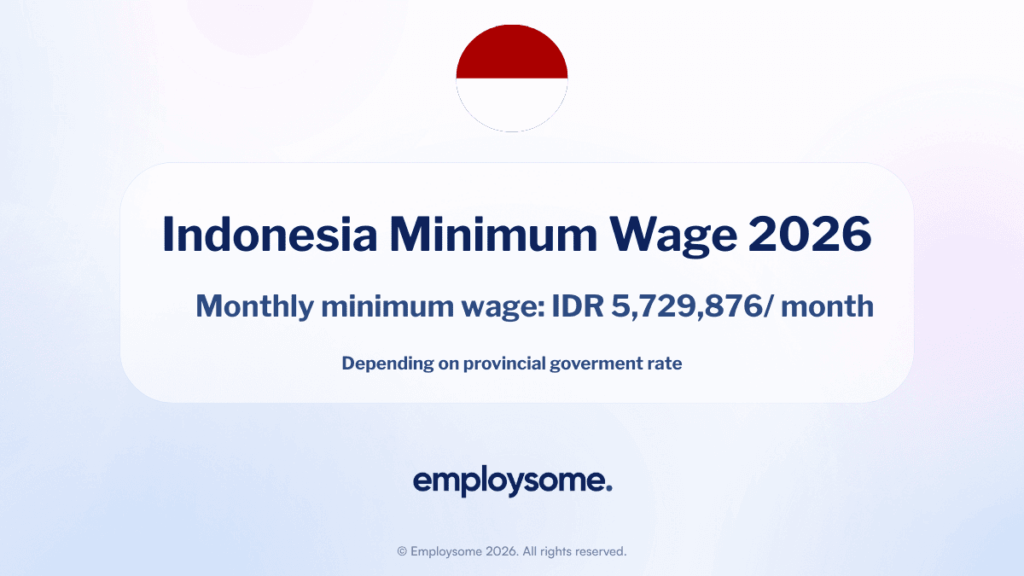
Table of Contents
- How Indonesia’s Minimum Wage System Works
- 2026 Minimum Wage Rates by Province
- Who the Minimum Wage Applies To
- Working Hours and Overtime
- Mandatory Benefits and Leave Entitlements
- Penalties for Non-Compliance
- Minimum Wage History: Jakarta
- Indonesia vs. ASEAN: Minimum Wage Comparison
- What International Companies Need to Know
- Final Takeaway

How Indonesia’s Minimum Wage System Works
Indonesia’s minimum wage framework operates on three levels:
- Provincial Minimum Wage (UMP = Upah Minimum Provinsi): Set annually by each provincial governor based on recommendations from the provincial Wage Council. The UMP is the baseline for the entire province.
- Regency/City Minimum Wage (UMK = Upah Minimum Kabupatenhttps://jdih.kemnaker.go.id/asset/data_puue/Perrmen_15_2018_eng.pdf/Kota): Set by regency or city authorities and must be equal to or higher than the provincial UMP. UMK rates often exceed the UMP in economically active areas.
- Sectoral Minimum Wage (UMSP/UMSK): Some provinces set higher minimum wages for specific industries (for example, star-rated hotels in Bali). Sectoral rates must equal or exceed the applicable UMP or UMK.
The minimum wage applies only to employees with less than one year of service. Employees with longer tenure must be paid under a Structure and Scale of Wages (Struktur dan Skala Upah / SUSU), which sets wages based on seniority, role, and performance. The SUSU must be implemented by the employer and wages under the SUSU must exceed the minimum wage.
The 2026 Wage Formula: Under Government Regulation No. 49 of 2025 (amending PP No. 36/2021 and PP No. 51/2023), the formula for calculating annual minimum wage increases is:
Minimum Wage Increase = Inflation + (Economic Growth × Alpha)
The alpha coefficient determines how much of economic growth is passed on to wage increases. For 2026, the alpha range was increased to 0.5–0.9 (up from 0.1–0.3 under the previous regulation). Each provincial Wage Council selects the specific alpha value within this range, which is why increases vary significantly across provinces; from approximately 5% to 8% depending on the region.
 Employsome Insight: Indonesia’s Minimum Wage Varies Massively by Location
The gap between the highest and lowest minimum wages in Indonesia is enormous. Jakarta’s 2026 UMP of IDR 5.73 million is nearly 2.5 times higher than UMK rates of IDR 2.3 million in parts of Central Java. For international companies, this means total employment cost can vary by 50–60% depending on where you hire. Companies building shared services centres, BPO operations, or development teams in Indonesia should carefully evaluate regional wage differences alongside talent availability, infrastructure, and logistics before deciding where to locate operations.
2026 Minimum Wage Rates by Province
Below are the 2026 provincial minimum wage (UMP) rates for Indonesia’s most economically significant provinces. All rates took effect on 1 January 2026.
|
Province |
2026 UMP (IDR/month) |
Increase |
Approx. USD |
|
DKI Jakarta |
5,729,876 |
6.17% |
~$342 |
|
West Java |
2,191,810 |
~6.5% |
~$131 |
|
Central Java |
2,327,386 |
7.28% |
~$139 |
|
East Java |
2,306,512 |
~6.5% |
~$138 |
|
Bali |
3,207,459 |
7.04% |
~$191 |
|
Riau Islands |
3,879,520 |
7.06% |
~$231 |
|
North Sumatra |
3,228,949 |
7.90% |
~$193 |
|
South Sulawesi |
3,658,738 |
~6.5% |
~$218 |
|
Yogyakarta (DIY) |
2,417,495 |
6.78% |
~$144 |
|
Bangka Belitung |
4,035,000 |
4.09% |
~$241 |
Important: The UMP is the provincial floor. Many regencies and cities set higher UMK rates. For example, Bekasi (West Java) has the highest UMK in Indonesia at approximately IDR 5.9 million, exceeding even Jakarta’s UMP. The average UMK across the 186 regencies/cities that reported for 2026 is approximately IDR 3.4 million per month.
Who the Minimum Wage Applies To
The minimum wage in Indonesia applies to:
- All employees under a contract of service (both fixed-term/PKWT and permanent/PKWTT)
- Local and foreign workers holding valid work permits (KITAS/KITAP)
- Full-time workers with less than one year of service at the company
- Workers paid monthly, daily, or by piece rate — total earnings must meet the applicable minimum wage
Key Distinctions
- Less than 1 year of service: The statutory minimum wage (UMP/UMK) applies as the floor.
- More than 1 year of service: Wages must follow the company’s Structure and Scale of Wages (SUSU), which must be higher than the minimum wage. Paying an employee with 3 years of tenure at exactly the minimum wage creates ‘wage compression’ and is discouraged by the Manpower Office (Disnaker).
- Probationary employees: Cannot be paid below the minimum wage during their probation period.
- Domestic workers: Not covered by the minimum wage framework under current labour law, though the government has signalled future reforms.
Mandatory Employer Contributions (BPJS)
Indonesia operates a dual social security system under BPJS (Badan Penyelenggara Jaminan Sosial), split into BPJS Kesehatan (healthcare) and BPJS Ketenagakerjaan (employment social security). Both are mandatory for all employers.
BPJS Kesehatan (Healthcare)
BPJS Kesehatan provides national health insurance covering the employee, their spouse, and up to three children.
- Employer contribution: 4% of monthly wages
- Employee contribution: 1% of monthly wages (deducted from salary)
- Wage cap for calculation: IDR 12,000,000 per month (contributions are not calculated on wages above this ceiling)
- Maximum employer contribution: IDR 480,000 per month
- Coverage: Employee + spouse + up to 3 children. An additional 1% per extra dependent is charged to the employee.
BPJS Ketenagakerjaan (Employment Social Security)
BPJS Ketenagakerjaan covers four programmes:
|
Programme |
Employer Rate |
Employee Rate |
Notes |
|
Work Accident Protection (JKK) |
0.24%–1.74% |
0% |
Rate depends on industry risk level |
|
Death Benefits (JKM) |
0.30% |
0% |
Employer-only |
|
Old Age Savings (JHT) |
3.70% |
2.00% |
Claimable at age 56 or permanent departure from Indonesia |
|
Pension (JP) |
2.00% |
1.00% |
Indonesian citizens only; wage cap IDR 10,547,400/month |
Foreign workers are enrolled in JKK, JKM, and JHT but are excluded from the Pension programme (JP). JHT contributions for foreign workers are claimable when they permanently leave Indonesia.
Job Loss Guarantee (JKP)
Introduced in 2022, the Job Loss Guarantee provides up to 6 months of financial assistance (60% of wages for 3 months, then 25% for 3 months, capped at IDR 5 million) plus career counselling and training for employees who are retrenched. JKP is funded by a combination of government funds and a reallocation of JKK/JKM contributions — there is no additional employer contribution for JKP.
Total Employer Cost Summary
For a minimum wage employee in Jakarta (IDR 5,729,876/month), assuming low-risk industry:
|
Component |
Amount (IDR/month) |
|
Gross salary (Jakarta UMP) |
5,729,876 |
|
BPJS Kesehatan (4%) |
229,195 |
|
JKK – Work Accident (0.24%) |
13,752 |
|
JKM – Death Benefits (0.30%) |
17,190 |
|
JHT – Old Age Savings (3.70%) |
212,005 |
|
JP – Pension (2.00%) |
114,598 |
|
Total employer contributions |
~586,740 (~10.2%) |
|
Total employer cost |
~6,316,616 per month |
Employers should budget approximately 10–13% above gross salary for mandatory BPJS contributions, depending on industry risk classification. In higher-risk industries (construction, mining), the JKK rate can reach 1.74%, pushing total employer contributions closer to 12–13%.
Employsome Insight: Indonesia’s Employer Burden Is Moderate by ASEAN Standards
At approximately 10–13% of gross salary, Indonesia’s mandatory employer contributions are lower than Malaysia’s (15–20% driven by EPF) and Vietnam’s (~21.5%), broadly comparable to the Philippines (~10–12%), and higher than Thailand (~5%). However, Indonesia’s complex multi-programme BPJS structure — with separate registration, reporting, and payment for healthcare and employment security — creates significant administrative overhead, particularly for foreign companies without local payroll expertise. Using an EOR in Indonesia eliminates this complexity entirely.
Working Hours and Overtime
Working hours in Indonesia are governed by Law 13/2003 on Manpower as amended by Law 6/2023 (Job Creation Law). Two standard schedules are permitted:
- 7 hours per day, 40 hours per week for a 6-day work week
- 8 hours per day, 40 hours per week for a 5-day work week
Key overtime rules:
- Maximum overtime: 4 hours per day, 18 hours per week
- Overtime on working days: 1.5× hourly rate for the first hour, 2× for subsequent hours
- Overtime on rest days/public holidays: 2× hourly rate for the first 8 hours, 3× for the 9th hour, 4× for the 10th and 11th hours
- Written consent: Employers must obtain written consent from the employee for overtime work
The overtime hourly rate is calculated as: monthly wage ÷ 173.
Mandatory Benefits and Leave Entitlements
Annual Leave
Employees who have completed 12 consecutive months of service are entitled to a minimum of 12 working days of paid annual leave per year.
Religious Holiday Allowance (THR)
All employers must pay Tunjangan Hari Raya (THR), a mandatory religious holiday bonus, at least 7 days before the employee’s major religious holiday (typically Idul Fitri for Muslim employees, Christmas for Christians, etc.). THR is equal to one month’s salary for employees with 12 months or more of continuous service, and prorated for those with less. THR is separate from the 13th-month salary concept used in some other countries and is a legally enforceable entitlement.
Other Leave
- Maternity leave: 3 months (1.5 months before and 1.5 months after delivery), fully paid
- Paternity leave: 2 days, fully paid
- Sick leave: Paid at 100% for the first 4 months, 75% for the next 4 months, 50% for the next 4 months, and 25% thereafter until termination (with medical certificate)
- Menstrual leave: 2 days per month for female employees experiencing pain (with notification to employer)
- Public holidays: Indonesia observes approximately 15–17 national public holidays per year, plus government-declared ‘joint leave’ days (cuti bersama)
Employsome Insight: THR Is a Major Cost That Many International Companies Overlook
The mandatory THR payment effectively creates a 13th month of salary each year. Unlike a discretionary bonus, THR is a legal obligation with strict timing requirements; it must be paid at least 7 days before the employee’s religious holiday. Late or non-payment of THR can result in fines of 5% of the total THR owed. International companies new to Indonesia should build THR into their annual compensation budget from day one. An EOR provider handles THR calculation, timing, and payment automatically as part of payroll management.
Penalties for Non-Compliance
Indonesia takes minimum wage violations seriously. Under Indonesian labour law:
- Paying below the minimum wage is a criminal offence — not merely an administrative violation. Employers can face imprisonment of 1–4 years and/or fines of IDR 100 million–IDR 400 million.
- Late BPJS contributions: BPJS Kesehatan and Ketenagakerjaan impose penalties for late or incomplete payments, and non-compliant employers may be denied access to government services and public procurement.
- Failure to implement SUSU: Employers who do not establish a Structure and Scale of Wages face administrative sanctions from the Manpower Office.
- Late THR payment: Fine of 5% of total THR amount owed.
- Blocked work permits: Non-compliance with BPJS obligations can result in the employer’s inability to sponsor or renew work permits (KITAS) for foreign employees.
The Manpower Office (Disnaker) conducts inspections and employees can file complaints directly.
Minimum Wage History: Jakarta
Jakarta, as the capital and highest-wage province, illustrates the trajectory of Indonesia’s minimum wage growth:
|
Year |
Jakarta UMP (IDR/month) |
Notes |
|
2018 |
3,648,035 |
|
|
2020 |
4,276,349 |
|
|
2022 |
4,641,854 |
Post-pandemic recovery |
|
2024 |
5,067,381 |
|
|
2025 |
5,396,761 |
6.5% increase |
|
2026 |
5,729,876 |
6.17% increase, alpha 0.75 |
Jakarta’s minimum wage has increased approximately 57% since 2018. The new alpha range of 0.5–0.9 introduced for 2026 signals the government’s intent to accelerate wage growth relative to the previous formula, which constrained increases through the lower 0.1–0.3 alpha range.
Indonesia vs. ASEAN: Minimum Wage Comparison
|
Country |
Monthly Min. Wage |
Approx. USD |
Employer Burden |
|
Indonesia (Jakarta) |
IDR 5,729,876 |
~$342 |
~10–13% |
|
Malaysia |
RM 1,700 |
~$370 |
~15–20% |
|
Thailand (highest) |
THB ~12,000 |
~$340 |
~5% |
|
Philippines (NCR) |
PHP ~14,040 |
~$245 |
~10–12% |
|
Vietnam (Region I) |
VND 4,960,000 |
~$195 |
~21.5% |
|
Indonesia (Central Java) |
IDR 2,327,386 |
~$139 |
~10–13% |
Indonesia’s minimum wage ranges from among the lowest in ASEAN (Central Java, Yogyakarta) to mid-range (Jakarta). The key differentiator is the massive regional variation within Indonesia itself — companies can achieve significantly different cost structures depending on which province or city they choose.
Employsome Insight: Indonesia Offers Cost Arbitrage Within a Single Country
Unlike most ASEAN countries that set a single national minimum wage (Malaysia, Thailand) or regional rates with modest variation (Philippines, Vietnam), Indonesia’s wage gap between provinces creates genuine cost arbitrage. A developer in Yogyakarta costs roughly 40% less than the same role in Jakarta in minimum wage terms, and the infrastructure gap has narrowed significantly with Trans-Java toll connectivity and improved digital infrastructure. For international companies, this means Indonesia can serve both premium (Jakarta) and cost-optimised (Central/East Java, Yogyakarta) talent strategies within one country and one legal framework.
What International Companies Need to Know
For companies based outside Indonesia that want to hire Indonesian workers, several practical considerations apply:
- You must pay the UMK for the employee’s work location, not the UMP. If the regency/city has set a higher minimum wage than the provincial UMP, the higher rate applies. Always verify both UMP and UMK for the specific location where the employee works.
- Wages must be paid in Indonesian Rupiah (IDR). Payment must follow the agreed payroll cycle, typically monthly.
- The minimum wage is the basic salary floor. Fixed allowances are included in the minimum wage calculation, but variable allowances and bonuses are not.
- BPJS registration is mandatory. Employers must register with both BPJS Kesehatan and BPJS Ketenagakerjaan. Foreign workers employed for more than 6 months must be enrolled in BPJS.
- THR must be budgeted annually. The mandatory religious holiday bonus of one month’s salary is a legal obligation, not discretionary. It must be paid at least 7 days before the employee’s religious holiday.
- Paying below the minimum wage is a criminal offence. Unlike many countries where minimum wage violations carry administrative fines, Indonesia imposes criminal penalties including imprisonment.
- Using an Employer of Record (EOR) is the most practical route for international companies without an Indonesian entity (PT PMA). An EOR becomes the legal employer, handles BPJS registration and contributions, manages THR and payroll in Rupiah, ensures UMP/UMK compliance for the correct location, and manages all Manpower Office reporting — removing the need to incorporate locally.
For a full breakdown of hiring requirements, employment contracts, and statutory obligations, see our Employer of Record in Indonesia guide.
Final Takeaway: Minimum Wage in Indonesia 2026
Indonesia’s minimum wage system is regional, complex, and subject to annual revision. For 2026, the new alpha range of 0.5–0.9 under Government Regulation No. 49/2025 has driven increases of 5–8% across most provinces, with Jakarta’s UMP rising to IDR 5,729,876 per month and the national average UMK sitting around IDR 3.4 million.
For employers, the compliance requirements include paying at least the applicable UMK (not just the UMP) for the employee’s work location, making timely BPJS Kesehatan and Ketenagakerjaan contributions, implementing a Structure and Scale of Wages for employees with more than one year of service, and paying THR at least 7 days before the relevant religious holiday. Total employer cost above gross salary is approximately 10–13% for mandatory BPJS contributions, plus the annual THR obligation.
International companies should note that minimum wage violations in Indonesia carry criminal penalties, not merely fines. Companies hiring in Indonesia without a local entity should work with an Employer of Record to handle BPJS registration, payroll, UMK compliance, and THR payments. For EOR provider comparisons in Indonesia, see our Best Employer of Record in Indonesia guide.

Written by
Christa is a Copywriter at Employsome with 17 years of professional writing experience across global brands, startups, and online publications. A native English-Finnish writer, she brings strong editorial skills and a versatile background in business, SaaS, and finance. At Employsome, Christa focuses on clear, practical content about HR, payroll, and Employer of Record topics.
Our content is created for informational purposes only and is not intended to provide any legal, tax, accounting, or financial advice. Please obtain separate advice from industry-specific professionals who may better understand your business’s needs. Read our Editorial Guidelines for further information on how our content is created.
Other posts
Review other blog posts