Minimum Wage in Egypt 2026: What Employers Need to Know
Egypt’s minimum wage is EGP 7,000 per month for private sector workers, with a new increase to EGP 8,000 announced for public sector employees from July 2026. This guide covers the full minimum wage framework under Egypt’s new Labour Law No. 14 of 2025, including employer social insurance contributions (18.75%), mandatory annual raises, overtime rates, income tax brackets, the profit-sharing obligation, and what it means for companies hiring through an EOR.
SEO Focus Keyword: minimum wage in Egypt

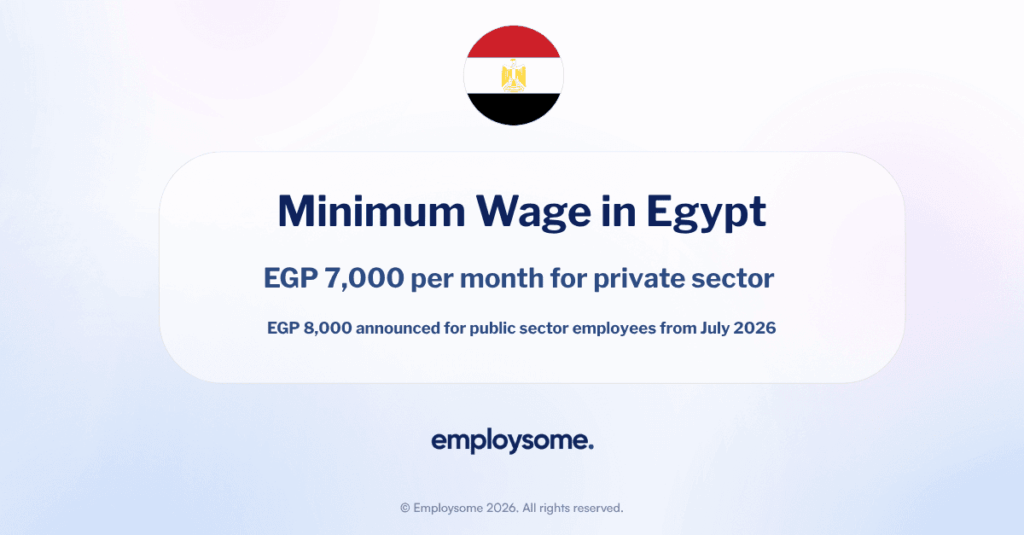
Table of Contents
Egypt’s minimum wage landscape has changed rapidly over the past three years. In January 2024 it was EGP 3,500. By May 2024 it had risen to EGP 6,000. In March 2025 it reached EGP 7,000. And on 2 April 2026, Prime Minister Mostafa Madbouly announced that the public sector minimum wage will rise to EGP 8,000 per month from July 2026, with a 21% increase in the total government wage bill for the 2026/27 fiscal year.
These rapid adjustments reflect persistent inflationary pressures and the structural reforms Egypt is implementing under its $8 billion Extended Fund Facility with the IMF. For international companies hiring in Egypt, the headline number is only the beginning. Social insurance contributions, mandatory annual raises, profit-sharing obligations, and the new Labour Law No. 14 of 2025 (which took effect on 1 September 2025) create a total employer cost that is significantly higher than the minimum wage alone.
This guide covers the full picture as it stands in April 2026, including the latest announced increases.
💡 Employsome Insight: Egypt has raised its minimum wage five times since January 2024. If your EOR is using salary figures from even 12 months ago, your payroll is almost certainly non-compliant. Verify that your provider is tracking National Council of Wages announcements and adjusting payroll in real time, not on a quarterly review cycle.

Current Minimum Wage Rates
Private sector: EGP 7,000 per month, effective 1 March 2025. This was set by the National Council of Wages (NCW) and applies to all private sector employers, with one exception: small-scale businesses with fewer than 10 workers are exempt from the minimum wage requirement.
Public sector: Currently EGP 7,000 per month (aligned from July 2025). Rising to EGP 8,000 per month from July 2026, as announced on 2 April 2026 by Prime Minister Madbouly. Employees under the Civil Service Law will receive a 12% annual raise, while those outside the Civil Service Law will receive a 15% raise. All public sector workers will also receive an additional monthly incentive of EGP 750.
Part-time workers: EGP 28 per hour (net), as set by the NCW. This is lower than the effective hourly equivalent of the full-time monthly minimum, which reflects the lower protections and benefits structure for part-time employment.
In USD terms: At current exchange rates (approximately EGP 50-54 per USD), the EGP 7,000 private sector minimum is roughly $130 to $140 per month. The upcoming EGP 8,000 public sector minimum will be approximately $148 to $160 per month. These figures fluctuate with the Egyptian Pound, which has experienced significant depreciation since the 2022 currency liberalisation.
The minimum wage includes all wage components, including the employer’s share of social insurance contributions. This is an important detail: the EGP 7,000 is not the base salary on top of which contributions are added. It is the total package including those contributions.
The Minimum Wage Timeline: 2022 to 2026
Egypt’s minimum wage has more than tripled in four years, reflecting the combined pressure of inflation, IMF reform requirements, and political commitments to social protection:
|
Date |
Private Sector Minimum |
Public Sector Minimum |
|
January 2022 |
EGP 2,400 |
EGP 2,400 |
|
January 2023 |
EGP 2,700 |
EGP 2,700 |
|
July 2023 |
EGP 3,000 |
EGP 3,000 |
|
January 2024 |
EGP 3,500 |
EGP 3,500 |
|
May 2024 |
EGP 6,000 |
EGP 4,000 |
|
March 2025 |
EGP 7,000 |
EGP 7,000 (from July 2025) |
|
July 2026 (announced) |
TBC |
EGP 8,000 |
The private sector minimum wage for July 2026 has not yet been confirmed separately. Historically, the NCW has aligned private sector minimums with public sector increases, but the timing and amount are decided independently by the Council. Employers should monitor NCW announcements closely, as a private sector increase to match the EGP 8,000 public sector level is widely expected.
💡 Employsome Insight: The pace of minimum wage increases in Egypt makes fixed-price EOR contracts risky. If your provider quoted a monthly cost in January and the minimum wage increases in March, someone is absorbing the difference. Verify whether your EOR contract includes automatic pass-through of statutory wage increases or whether you need to renegotiate each time the NCW announces a change.
Mandatory Annual Raises
Under Egypt’s new Labour Law No. 14 of 2025, private sector employers are required to provide an annual raise of at least 3% of the employee’s social insurance wage, with a minimum floor of EGP 250 per month. This is not optional. It is a statutory entitlement that applies every year, regardless of the employee’s performance or the company’s financial position.
The 3% is calculated on the social insurance wage, not the total salary. Since the social insurance wage is capped at the maximum insurable salary (currently EGP 16,700 per month as of January 2026), the raise for higher-earning employees is effectively capped at 3% of that maximum, which is approximately EGP 501 per month. For employees at or near the minimum wage, the EGP 250 floor ensures a meaningful annual increase even if 3% of their insurable salary would produce a lower figure.
This mandatory raise compounds over time and creates predictable annual cost increases that must be built into employment budgets from day one.
Employer Social Insurance Contributions
Social insurance is mandatory for all employees in Egypt and is administered by the Social Insurance Authority. Both employer and employee contributions are calculated as a percentage of the insurable salary, which has a floor and a ceiling.
As of January 2026, the insurable salary floor is EGP 2,700 per month and the ceiling is EGP 16,700 per month. These caps increase by 15% annually until 2027, then adjust for inflation from 2028 onward.
- Employer contribution: 18.75% of the insurable salary, covering pension, disability, survivor benefits, work injury, and unemployment insurance.
- Employee contribution: 11% of the insurable salary, deducted at source through payroll.
- Health insurance: Employers contribute 3.25% and employees contribute 1% under the Universal Health Insurance system that is being progressively rolled out across governorates.
For an employee earning EGP 7,000 per month at the minimum wage, the employer’s social insurance contribution is approximately EGP 1,313 per month (18.75% of EGP 7,000). The employee’s deduction is EGP 770 (11% of EGP 7,000). Combined with the health insurance contributions, the total employer overhead on social insurance alone is approximately 22% of the insurable salary.
💡 Employsome Insight: Egypt’s social insurance caps increase automatically by 15% each year until 2027. This means the ceiling for insurable salary rises from EGP 16,700 in 2026 to approximately EGP 19,205 in 2027. Employer contributions are calculated on the actual salary up to this cap, so as the cap increases, your social insurance costs rise even if the employee’s salary stays the same. Build this annual escalation into your total cost modelling.
Profit-Sharing Obligation
This is one of the most commonly overlooked employer costs in Egypt. Under the Labour Law, employers are required to distribute at least 10% of their annual net profits to employees, up to a cap equivalent to one year’s salary per employee. This is not a discretionary bonus. It is a statutory obligation.
The profit share is calculated on the company’s net profits after tax and is distributed proportionally among employees based on their salary. Companies that are not profitable in a given year have no obligation, but any company generating a net profit must comply. This applies to both local and foreign-owned companies operating in Egypt.
For international companies hiring through an EOR, the profit-sharing obligation sits with the EOR entity, not the client company. However, the way EOR providers handle this varies. Some factor it into their monthly management fee; others treat it as a pass-through cost at year-end. Clarify this before signing.
Working Hours and Overtime
Standard working hours in Egypt are 8 hours per day and 48 hours per week, distributed over 6 working days. In practice, many private sector employers operate a 40 to 42 hour week over 5 days, though the 48-hour maximum remains the legal framework.
Overtime is limited to a maximum of 2 hours per day, and employers must provide at least 24 hours’ notice before assigning overtime work. The Ministry of Labor must be notified at least 7 days in advance of any extended work period. Total time at the workplace, including overtime, must not exceed 12 hours in any day.
Overtime rates under the Labour Law are:
|
Type |
Rate |
|
Daytime overtime |
135% of regular hourly wage |
|
Nighttime overtime (after 10pm) |
170% of regular hourly wage |
|
Work on weekly rest day |
Additional day’s wage + compensatory day off |
|
Work on public holidays |
300% of daily wage |
Employees who are pregnant are entitled to reduced working hours (at least one hour less per day) from the sixth month of pregnancy and cannot be required to work overtime during pregnancy or for six months after childbirth.
Income Tax
Egypt has no separate payroll tax, but employers must withhold income tax from employee salaries. The tax system is progressive, with a personal exemption of EGP 20,000 per year for residents. The brackets for annual income (as of 2025/2026) are:
|
Annual Income (EGP) |
Tax Rate |
|
Up to 40,000 |
0% |
|
40,001 to 55,000 |
10% |
|
55,001 to 70,000 |
15% |
|
70,001 to 200,000 |
20% |
|
200,001 to 400,000 |
22.5% |
|
400,001 to 1,200,000 |
25% |
|
Above 1,200,000 |
27.5% |
An employee earning the minimum wage of EGP 7,000 per month (EGP 84,000 annually) falls into the 20% bracket for the portion above EGP 70,000, but after the personal exemption, their effective tax burden is modest. Higher-earning professionals face meaningful tax rates, particularly above EGP 200,000 annually.
Leave Entitlements
Under Egypt’s Labour Law, employees are entitled to 21 days of paid annual leave after completing one year of service (pro-rated for service of 6 months or more). This increases to 30 days after 10 consecutive years of service or once the employee reaches 50 years of age. Employees working in remote or hazardous environments receive an additional 7 days.
Maternity leave under the new Labour Law No. 14 of 2025 has been increased to 120 days (approximately 4 months), usable up to three times over the employee’s career. The Social Insurance Authority pays a maternity benefit equal to 75% of the insured wage, provided the employee has at least 10 months of insurance contributions. The employer continues to pay the full salary and offsets the social insurance payment against it, so the employee receives her full wage during leave.
Paternity leave is 1 paid day per child, for up to three children. Sick leave is compensated at 100% for the first 3 months, 85% for the next 6 months, and 75% for the following 3 months.
Egypt observes approximately 14 public holidays per year, including Islamic holidays (which vary annually based on the lunar calendar) and national secular holidays. Employees who work on public holidays receive 300% of their daily wage.
Regional Comparison
Comparison
|
Country |
Min. Wage (Monthly) |
Approx. USD |
Employer SI |
Income Tax |
Working Hours |
|
Egypt |
EGP 7,000 |
~$135 |
18.75% |
0-27.5% |
48hrs/week |
|
Saudi Arabia |
SAR 4,000 (nationals) |
~$1,067 |
14% (nationals) |
0% |
48hrs/week |
|
UAE |
None universal |
Varies |
12.5% (nationals) |
0% personal |
48hrs/week |
|
Jordan |
JOD 260 |
~$367 |
14.25% |
0-30% |
48hrs/week |
|
Morocco |
MAD 3,111 |
~$310 |
~26% |
0-38% |
44hrs/week |
|
Tunisia |
TND 465 |
~$150 |
~16% |
0-35% |
48hrs/week |
Egypt’s minimum wage is among the lowest in the MENA region in absolute USD terms, but the pace of increases has been the fastest. The combination of no personal income tax for low earners, relatively low employer contributions compared to North Africa, and a large skilled labour pool makes Egypt competitive for cost-sensitive hiring, particularly in technology, customer support, and back-office operations.
What This Means for Companies Hiring Through an EOR
If you are hiring employees in Egypt through an Employer of Record, the EOR is the legal employer and is responsible for paying at least the NCW minimum wage and implementing mandatory annual raises, registering employees with the Social Insurance Authority and calculating contributions correctly within the insurable salary bands, withholding income tax at the correct progressive rates, managing the profit-sharing obligation at year-end, complying with overtime limits and compensation rates under the new Labour Law, and administering leave entitlements including the expanded 120-day maternity leave.
Egypt’s rapid wage increases and the new Labour Law (which replaced the 2003 law) mean that compliance requirements have changed significantly. Providers using outdated templates or salary structures risk non-compliance with the current framework. For a broader overview of how to structure international hiring compliantly across different regulatory environments, see our international hiring guide.
Hiring in Egypt?
If you are looking to hire employees in Egypt without setting up a local entity, an Employer of Record handles employment contracts, social insurance registration, payroll tax withholding, and compliance with Egypt’s new Labour Law on your behalf. See our Best Employer of Record in Egypt guide to understand how the model works, or contact us for provider comparisons.
Frequently Asked Questions
EGP 7,000 per month for private sector workers (since March 2025). Public sector employees will receive EGP 8,000 per month from July 2026. Small businesses with fewer than 10 workers are currently exempt.
Yes. The minimum wage applies to all employees regardless of nationality. Foreign workers employed in Egypt must receive at least the NCW minimum.
Social insurance (18.75%), health insurance (3.25%), mandatory annual raise (minimum 3% or EGP 250), and profit-sharing (10% of net profits). Total employer overhead is approximately 25 to 30% above gross salary depending on the salary level and profit-sharing obligation.
Labour Law No. 14 of 2025 took effect on 1 September 2025, replacing the 2003 law. Key changes include increased maternity leave (120 days, 3 times per career), mandatory 3% annual raises, formal recognition of remote and flexible work, probation limited to 3 months, termination only through labour court decisions, and expanded protections against harassment and discrimination.
Frequently. Egypt has adjusted the minimum wage five times since January 2024. The National Council of Wages reviews and sets the private sector minimum, while public sector increases are announced as part of the annual fiscal budget (July to June fiscal year).
Employers must distribute at least 10% of annual net profits to employees, capped at one year’s salary per employee. This is statutory, not discretionary.

Written by
Dane Cobain is a Copywriter at Employsome and an accomplished author whose work spans fiction, non-fiction, and professional writing. Over the past decade, he has built a strong track record creating straightforward content for the HR, payroll, and corporate sectors. Dane brings a storyteller’s eye to the evolving world of global employment, with a particular focus on Employer of Record and PEO models. His articles explore industry trends and dedicated Best Of Guides when managing an international workforce.
Our content is created for informational purposes only and is not intended to provide any legal, tax, accounting, or financial advice. Please obtain separate advice from industry-specific professionals who may better understand your business’ needs. Read our Editorial Guidelines for further information on how our content is created.
Other posts
Along with our standard maps we offer highly customizable maps.