A Legal Reality Check from Bowmans on EOR in South Africa
Bowmans partners Melissa Cogger and Nikita Solanki explain what really happens when a foreign company uses an Employer of Record in South Africa. The TES classification, the earnings threshold that triggers deemed employment, and why clients are rarely as protected as they think.

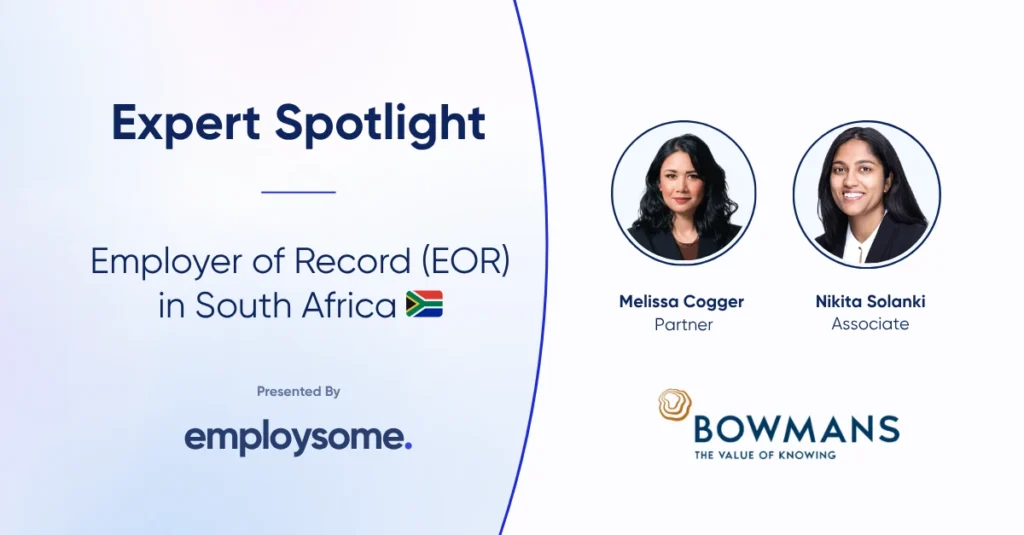
Welcome to Employsome Expert Spotlight, a series where we put specific legal questions to employment lawyers who advise foreign companies in key Employer of Record (EOR) markets. No marketing language, no provider spin. Just independent legal perspective from practitioners who deal with these structures every day.
For this edition, we spoke with Melissa Cogger, Partner in the Employment and Benefits practice at Bowmans, and Nikita Solanki, Associate in the same practice. Both are based in Bowmans’ Cape Town office and advise foreign multinationals on the full lifecycle of South African employment compliance, from triangular EOR arrangements through to CCMA disputes and retrenchments.
Bowmans is widely regarded as the pre-eminent law firm in Africa, with offices across the continent and a market-leading employment and benefits practice. It was named African Firm of the Year and South African Firm of the Year at the IFLR Africa Awards 2026. Their answers below are direct and lightly edited for clarity. If you are evaluating whether to use an EOR in South Africa, this is the perspective your legal counsel would give you.
This interview was conducted in May 2026 and reflects the legal landscape at that time.

About the Experts
Melissa Cogger is a Partner in the Employment and Benefits practice at Bowmans, based in Cape Town. She advises multinational employers on the full spectrum of South African labour law, including unfair dismissal disputes, retrenchments, workplace investigations, employment equity, and Broad-Based Black Economic Empowerment compliance. She regularly appears before the CCMA, Labour Court, and High Court, and is one of South Africa’s most published employment lawyers on employment equity reform, with over 25 articles to her name. She serves on the executive committee of the South African Society for Labour Law, Western Cape Chapter.
Nikita Solanki is an Associate in Bowmans’ Employment and Benefits practice in Cape Town. She co-authors this Expert Spotlight and advises on individual and collective labour law, employment contracts, restructurings, and compliance with the Labour Relations Act, the Basic Conditions of Employment Act, and the Employment Equity Act. Together, they bring both senior partner experience and current technical depth to the questions foreign companies ask before signing an EOR contract for South Africa.
Key Takeaways
- An EOR arrangement in South Africa is most likely to be classified as a Temporary Employment Service (TES) under section 198 of the Labour Relations Act. This is the locally regulated equivalent of a labour broker arrangement, and it sits inside one of the most heavily regulated parts of South African labour law.
- The Earnings Threshold (currently R261,748.45 per annum, rising to R269,600.90 from 1 May 2026) is the single most important number in the analysis. For employees earning below it, the deeming provisions in section 198A of the LRA can treat the client (the foreign company) as the actual employer for LRA purposes if the work is not genuinely temporary.
- South African law does not recognise employment-at-will. A dismissal must be both substantively and procedurally fair. An EOR cannot terminate an employee by serving notice alone, and the wrong process can result in compensation of up to 12 months’ remuneration, or up to 24 months where dismissal is linked to discrimination.
- Permanent establishment risk is not mitigated by using an EOR. Whether hiring through an EOR creates a PE for a foreign company depends on the substance of the work, the applicable double taxation agreement, and the source of income, and is a fact-specific tax analysis that EOR providers are not equipped to give.
- Joint and several liability between the EOR and the client applies for certain breaches of legislation, collective agreements, conditions of employment, and arbitration awards, even where employees earn above the Earnings Threshold. The employee can sue either party or both.
- EORs remain a practical entry point for foreign companies that are not ready to incorporate in South Africa, but the service-level agreement matters more than the marketing. Most EOR contracts are drafted to protect the EOR, not the client.
What an EOR Actually Is in South Africa
EOR providers globally market themselves as a simple way to hire abroad without an entity. In South Africa, the legal reality is more specific. We asked Melissa and Nikita what is actually happening when a foreign company signs an EOR contract for South Africa.
“In an EOR arrangement, the EOR employs the individual in South Africa directly and then assigns the person’s services to the client (the foreign company) for a fee. An EOR arrangement is likely to be considered by South African employment tribunals to be a Temporary Employment Service (TES), commonly referred to as a labour broker arrangement. These arrangements are strictly regulated by the Labour Relations Act 66 of 1995.
The LRA regulates the provision of work through a TES, with the consequences for the TES and its clients differing materially depending on whether the employees earn above or below the Earnings Threshold determined by the Minister of Employment and Labour. Foreign companies wanting to make use of EOR arrangements should carefully consider the legal consequences of engaging a TES in South Africa, particularly if employees earn below the Earnings Threshold and the arrangement is not genuine temporary work.
Melissa Cogger & Nikita Solanki, Bowmans
In South Africa, an EOR is not a neutral payroll vehicle — it is a regulated TES
This is the framing most EOR providers will not surface in a sales call. An EOR in South Africa is a TES inside section 198 of the LRA, the same legal box as a traditional labour broker. The consequences sit on a spectrum: light-touch joint liability for high earners, deemed-employer exposure for the client for lower earners doing non-temporary work. Before signing an EOR contract for South Africa, you should understand which side of the Earnings Threshold each role sits on. For a comparison of providers with South African coverage and infrastructure, see our Best EOR for South Africa guide.
The Earnings Threshold That Changes the Risk Profile
The single most important number for any foreign company evaluating an EOR in South Africa is the Earnings Threshold set by the Minister of Employment and Labour. It determines whether the deeming provisions of the LRA kick in. We asked Melissa and Nikita to explain how it actually works.
“The Earnings Threshold is currently R261,748.45 per annum (approximately R21,812.37 per month), which will be increased to R269,600.90 per annum (approximately R22,466.74 per month) effective 1 May 2026. For employees earning below this figure, one of the most significant consequences of using a TES is the ‘deemed’ employment provision in section 198A of the LRA.
TES workers earning below the Earnings Threshold will, with very few exceptions, only be regarded as employed by the TES if they are performing ‘temporary services’ as defined in the Act. If not, they will be deemed to be employees of the client for the purposes of the LRA. ‘Temporary service’ has a specific definition: work for a period not exceeding three months, work as a substitute for a temporarily absent employee, or a category of work designated as temporary by a collective agreement, sectoral determination, or Ministerial notice.
Melissa Cogger & Nikita Solanki, Bowmans
Hiring below the threshold is almost always deemed-employer territory
Most EOR engagements are not three-month substitutions. They are open-ended remote hires for software engineers, customer success roles, or product managers. For senior or specialist roles paying well above R270k, the client mostly relies on the section 198(2) defence (the TES is the employer). For roles paying below the threshold, almost no EOR placement will meet the strict ‘temporary service’ test, which means the foreign company can be deemed the actual employer for LRA purposes, with full unfair dismissal exposure. This is the single most under-discussed risk in South African EOR sales pitches. For context on what salary levels look like by role and sector, see our Average Salary in South Africa guide.
No Employment-at-Will: How Termination Actually Works
Foreign companies hiring through an EOR in South Africa often arrive with US or UK termination assumptions baked in. South African law operates on different principles. We asked Melissa and Nikita to walk us through what foreign companies need to understand before they ask their EOR to ‘offboard’ someone.
“The LRA provides significant protection against unfair dismissals and unfair labour practices. In our law, a dismissal must be substantively and procedurally fair. This means the employer must have a fair reason to dismiss an employee and follow a fair procedure in giving effect to the dismissal. Employees’ contracts of employment cannot be terminated simply by the giving of notice, and our law does not recognise ‘employment-at-will’.
In an unfair dismissal claim, the individual could be awarded up to 12 months’ remuneration as compensation, or reinstatement with back pay. If the reason for the dismissal is linked to a prohibited ground, such as unfair discrimination, the individual could be awarded up to 24 months’ remuneration. Where employees are retrenched on operational grounds, they are entitled to be paid one week’s remuneration for every completed year of service as severance pay (which may be increased by collective bargaining agreements), accrued leave pay, notice pay if they do not serve notice, and any other amounts contractually owed.
Melissa Cogger & Nikita Solanki, Bowmans
‘Offboard them this week’ is a phrase that triggers procedural unfair dismissal exposure
Termination is where EOR compliance failures become expensive in South Africa. The exposure is not the statutory notice (which is short, one to four weeks), it is the unfair dismissal jurisprudence enforced through the CCMA. A foreign company that asks its EOR to ‘let someone go quickly’ is often asking the EOR to commit a procedural unfair dismissal. Before signing an EOR contract, ask the provider to walk you through their actual termination process for misconduct, poor performance, and operational requirements, three distinct procedures with different procedural standards. If the EOR account manager cannot describe these in detail, that is the red flag.
The Misclassification Test: ‘Dominant Impression’
Many foreign companies that resist the EOR conversation eventually ask whether they can just engage their South African hire as an independent contractor. We asked Melissa and Nikita how South African law actually approaches that question.
“Our courts have grappled with the distinction between who is an employee and who is not over many years and have developed an approach referred to as the ‘dominant impression’ test. The courts weigh all the different elements of the relationship to decide, on balance, whether the relationship is one of employment. There is no single factor that decisively indicates the presence or absence of an employment relationship, and the fact that a contract describes the incumbent as an independent contractor is not the end of the matter.
The LRA Code of Good Practice elaborates on the factors: whether the manner and hours of work are subject to the control or direction of another person, whether the person forms part of the organisation, whether they are economically dependent on the person they work for, whether they are provided with tools of trade or equipment, and whether they supply services to only one person. Employment legislation contains a rebuttable presumption: for persons earning below the Earnings Threshold, the presence of any one of these factors gives rise to a presumption of employment, placing the onus on the employer to prove otherwise.
Melissa Cogger & Nikita Solanki, Bowmans
Substance over form, with the burden of proof shifted onto the company
This is the same pattern we heard from Khaitan & Co. in India and Montgomery Law in Brazil: substance over form. The contractor label means very little if the working relationship looks like employment. The South African twist is the rebuttable presumption for employees earning below the Earnings Threshold, which actively shifts the legal burden onto the company. CCMA arbitrators are well versed in working through the dominant impression factors, and a typical contractor agreement drafted by a US-based legal team will not survive that scrutiny. If the role is operational, integrated into your team, and economically dependent on your company, classify it as employment from the start.
The Permanent Establishment Question
One of the most frequently misunderstood aspects of EOR arrangements globally is whether they protect a foreign company against permanent establishment (PE) risk. We asked Melissa and Nikita where foreign companies typically get this wrong in South Africa.
“We often see foreign companies getting this wrong as they have not carefully sought legal advice on the potential tax consequences of an EOR arrangement and have assumed that an EOR arrangement would mitigate the risk of any potential tax consequences. This is not the case.
The answer as to whether a PE risk is created when a foreign company hires employees in South Africa via an EOR is subject to various factual considerations: substance over form, whether a double taxation agreement is in place between South Africa and the jurisdiction where the foreign entity is tax resident, and whether the foreign entity is receiving income from a South African ‘source’ attributable to a PE in South Africa. Moreover, under South African law, even where no liability to tax arises, non-resident companies are still required in certain instances to register as taxpayers in South Africa and submit returns, including where they carry on a trade through a PE.
Melissa Cogger & Nikita Solanki, Bowmans
‘Entity-free hiring’ does not neutralise PE risk
This is the most important paragraph in this entire interview for anyone reading it through a CFO lens. EOR providers frequently market ‘entity-free hiring’ as if it neutralises PE risk. It does not. Whether your South African hires create a PE depends on what those people actually do (sales authority, contract-concluding capacity, dependent agent status), what your country’s treaty with South Africa says, and whether SARS considers your income South African-sourced. The right answer is a tax memo from local counsel, scoped to the specific role and the specific treaty, not a reassurance from your EOR account manager.
Joint and Several Liability: What the Client Always Owns
The EOR sales pitch tends to imply that the client offloads employment liability. South African law tells a different story. We asked Melissa and Nikita where the client retains direct legal exposure even when an EOR sits in between.
“Section 198 of the LRA makes provision for joint and several liability between the TES (the EOR) and the client in relation to certain breaches of legislation, collective agreements, conditions of employment, or binding arbitration awards, even where the placed employees earn in excess of the Earnings Threshold. Where there is joint and several liability, the placed worker may institute proceedings against either the TES or the client, or both, and may enforce an award against either party.
In South Africa, it is also possible for an employee to be employed by two or more co-employers. A worker may be able to demonstrate that they are employed by both the TES and the client, depending on the factual circumstances and the substance of the relationship. In addition, we recommend that a client obtain legal advice before entering into a service level agreement with an EOR in South Africa, as service level agreements are often drafted to protect the EOR and not the client.
Melissa Cogger & Nikita Solanki, Bowmans
Read the indemnity clauses before you read the marketing
This is the line that should change how you read your EOR service agreement: ‘service level agreements are often drafted to protect the EOR and not the client.’ The indemnity clauses, the carve-outs on statutory breaches, the language around CCMA exposure: these are the provisions that determine who actually pays when a claim hits. Joint and several liability under section 198 is not negotiable away under South African law, but the contractual allocation of risk between EOR and client absolutely is. Before signing, have local counsel review the indemnity and liability sections. The cost is trivial compared to a single CCMA award.
One Piece of Advice
We asked Melissa and Nikita for the single most important thing a founder or HR director should understand before signing an EOR contract for South Africa.
“From a South African law perspective, the primary red flags a client needs to consider are: (a) whether a permanent establishment is being created via the arrangement, in which case specialist tax advice should be sought; (b) whether the arrangement raises the risk of the deeming provisions in the LRA being applicable; and (c) whether the EOR complies with its obligations under South African law, particularly where there is joint and several liability.
Foreign companies have shown growing interest in using EOR service providers to engage workers in South Africa, a natural consequence of the increase in remote working arrangements globally. South African law is responding incrementally, with draft amendments proposing major changes to gig work, organisational rights, and dismissal procedures. The direction of travel is towards more flexibility, but with continued strong employee protection. Choose your EOR partner with that in mind.
Melissa Cogger & Nikita Solanki, Bowmans
About Employsome Expert Spotlight: This series features independent legal commentary from employment lawyers who advise foreign companies in key EOR markets. Experts are not compensated and editorial control remains with Employsome. The views expressed are those of the individual lawyers and do not constitute legal advice. For country-specific legal guidance, consult qualified local counsel.
Comparing EOR options for South Africa?
See pricing, scoring, and country fit for Employer of Record providers, side by side.
Get started free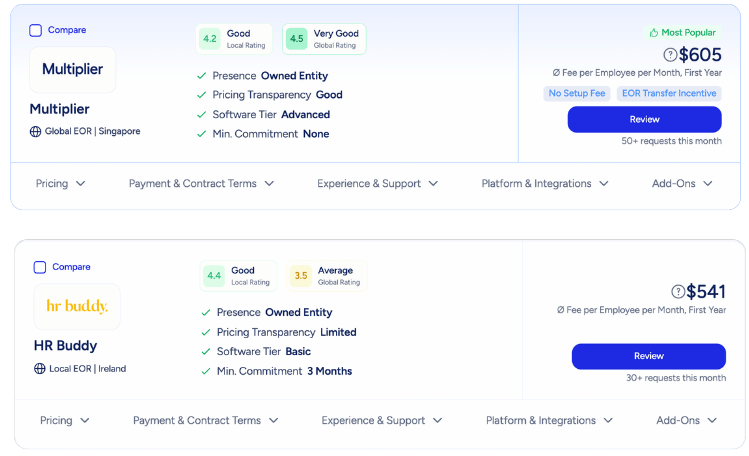
Copywriter
Christa is a Copywriter at Employsome with 17 years of professional writing experience across global brands, startups, and online publications. A native English-Finnish writer, she brings strong editorial skills and a versatile background in business, SaaS, and finance. At Employsome, Christa focuses on clear, practical content about HR, payroll, and Employer of Record topics.
Our content is created for informational purposes only and is not intended to provide any legal, tax, accounting, or financial advice. Please obtain separate advice from industry-specific professionals who may better understand your business’s needs. Read our Editorial Guidelines for further information on how our content is created.
Other posts
Read More Expert Spotlights