Average Salary Spain 2026: By Region, Industry & Role
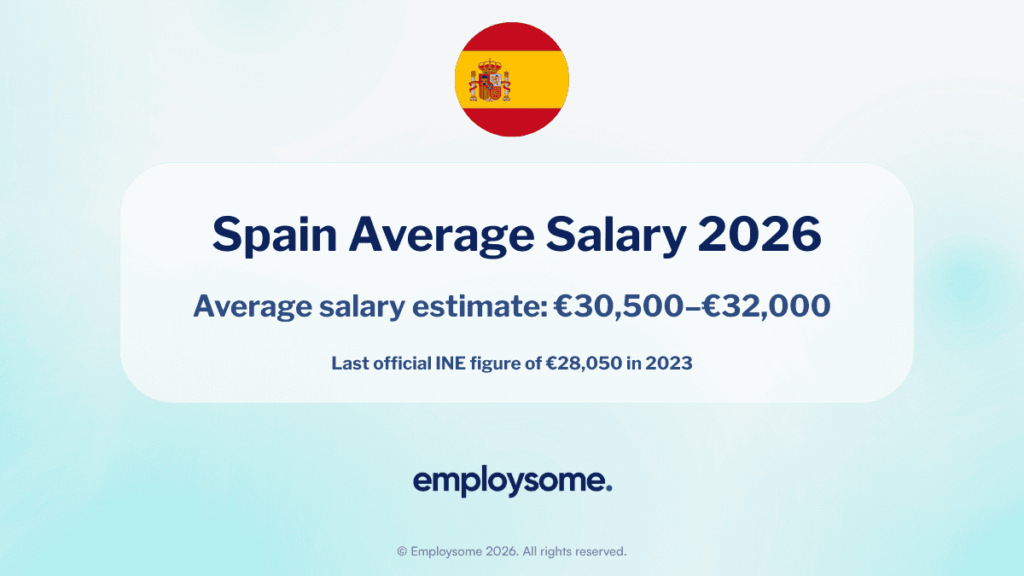
The average gross annual salary in Spain is approximately €30,500 – €32,000 in 2026, up from the last official INE figure of €28,050 in 2023. The median is significantly lower at approximately €23,000, reflecting Spain’s concentration of low-wage service sector employment. This guide covers national averages, regional breakdowns across all 17 autonomous communities, industry salary benchmarks, the gender pay gap, how Spain compares to other European countries, and what these figures mean for employers hiring in the Spanish market.


Average Salary in Spain: National Overview
The most recent official data from Spain’s Instituto Nacional de Estadística (INE), published in May 2025, recorded an average gross annual salary of €28,049.94 for 2023, a 4.1% increase from the previous year. INE publishes salary data with a significant lag, so this remains the last confirmed official figure. Based on continued wage growth driven by collective bargaining agreements (approximately 3-4% annual increases), minimum wage hikes, and sustained demand for skilled professionals, the average gross annual salary in Spain in 2026 is estimated at €30,500-€32,000.
|
Metric |
Amount |
|
Average gross annual salary (2026 est.) |
€30,500-€32,000 |
|
Last official INE figure (2023) |
€28,049.94 |
|
Average gross monthly (12 payments) |
~€2,540-€2,670 |
|
Median gross annual salary (INE 2023) |
~€23,000 |
|
Average net monthly take-home |
~€1,700-€1,800 |
|
Minimum wage (SMI) 2026, 14 payments |
€1,221/month (€17,094/year) |
|
EU average gross monthly salary (Eurostat 2024) |
~€3,155 |
A critical distinction for employers: Spanish salaries are typically paid across 14 payments per year (12 monthly payments plus two extra payments in July and December, known as pagas extraordinarias). When sources quote a monthly salary, confirm whether it is based on 12 or 14 payments, as this changes the monthly figure by approximately 17%.
 Employsome Insight: The Average Is Misleading; The Median Tells the Real Story
Spain’s estimated average salary of €30,500-€32,000 is pulled upward by high earners in finance, technology, and management. The median salary is approximately €23,000 (INE 2023), meaning half of all Spanish workers earn less than this. For employers benchmarking compensation, the median is a more reliable indicator of what ‘typical’ employees actually earn. If you are hiring for roles in hospitality, retail, agriculture, or entry-level services, the relevant benchmark is significantly below the average.
Average Salary by Region (Autonomous Community)
Spain’s salary landscape varies dramatically by region. The gap between the highest-paying autonomous communities (Basque Country and Madrid) and the lowest-paying (Extremadura and Canary Islands) exceeds €10,000 – €16,000 annually based on 2026 estimates. This regional variation reflects differences in industrial base, cost of living, sectoral composition, and concentration of high-value employers.
|
Autonomous Community |
Last Official INE Figure (2022) |
2026 Estimate (Regional) |
|
Basque Country (País Vasco) |
€32,313 |
~€35,500 – €37,000 |
|
Community of Madrid |
€31,230 |
~€34,000 – €36,000 |
|
Navarra |
€29,189 |
~€32,000 – €33,000 |
|
Catalonia |
~€28,500 |
~€31,000 – €33,000 |
|
Aragon |
~€26,500 |
~€29,000 |
|
Valencian Community |
~€24,500 |
~€27,000 |
|
Andalusia |
~€23,200 |
~€25,500 |
|
Canary Islands |
~€22,500 |
~€24,500 |
|
Extremadura |
~€21,922 |
~€23,500 |
Note: These are regional averages across the entire autonomous community, including both urban and rural areas. City-level salaries in major urban centres are significantly higher than these regional figures.
The city-level picture adds further nuance. In Madrid city, average salaries for full-time roles range from €38,000 to €42,000, driven by the concentration of finance, technology, and corporate headquarters. In Barcelona, the range is €36,000 to €38,000, with strengths in tech, logistics, and professional services. These city-level figures are substantially higher than the Community of Madrid or Catalonia regional averages because the regional data includes lower-wage suburban and rural areas.
Employsome Insight: Regional Salary Gaps Matter More Than National Averages for Hiring Decisions
If you are hiring in Spain, the national average of €30,500 – €32,000 is almost meaningless in isolation. A software developer in Madrid earns 50 – 80% more than the same role in Andalusia. A customer service agent in Barcelona costs significantly more than one in Valencia. Always benchmark salaries against the specific autonomous community and city where the employee will be based, not the national figure. Many international companies peg salaries to Madrid or Barcelona rates and are surprised when candidates in secondary cities consider the offer above market.
Average Salary by Industry
Spain’s salary distribution is heavily influenced by sector. The highest-paying industries are energy, finance, technology, and pharmaceuticals. The lowest are hospitality, agriculture, and domestic services, which employ a large share of the workforce.
|
Industry / Sector |
Avg. Annual Gross (Approx.) |
|
Energy, gas, steam & air conditioning |
€54,448 (INE 2023, highest) |
|
Finance & insurance |
€45,000 – €55,000 |
|
Information & communication (IT/tech) |
€40,000 – €50,000 |
|
Pharmaceuticals & biotechnology |
€40,000 – €48,000 |
|
Professional, scientific & technical services |
€35,000 – €45,000 |
|
Manufacturing & engineering |
€30,000 – €40,000 |
|
Public administration & education |
€28,000 – €35,000 |
|
Construction |
€25,000 – €30,000 |
|
Retail & wholesale trade |
€22,000 – €28,000 |
|
Agriculture & fishing |
€18,000 – €22,000 |
|
Accommodation & food services (hospitality) |
€16,986 (INE 2023, lowest) |
The gap between the highest-paying sector (energy at €54,448) and the lowest (hospitality at €16,986) is over €37,000 annually. This three-to-one ratio reflects Spain’s structural economic challenge: the services sector employs over 75% of the workforce, but many of these jobs are in low-wage hospitality, retail, and tourism roles that pull the national median down.
Employsome Insight: Spain’s Tech Salaries Are Competitive When Adjusted for Cost of Living
An experienced software developer in Madrid earning €45,000 – 60,000 gross has a comparable or better standard of living than a developer earning €70,000 – 80,000 in London or €80,000 – 90,000 in Munich, once housing, taxes, and daily expenses are factored in. For international companies building remote tech teams, Spain offers strong technical talent at 30-50% lower total employment cost than Western European alternatives, with a significantly better quality of life proposition for the employee.
Gender Pay Gap in Spain
Spain’s gender pay gap has been narrowing but remains significant. According to the most recent INE data (2023):
- Average female salary: €25,591 gross/year
- Average male salary: €30,372 gross/year
- Gender pay gap: Approximately 15.7% (raw, unadjusted)
The gap is driven by several structural factors: women are overrepresented in lower-paying sectors (hospitality, retail, domestic work), more women work part-time, and a ‘glass ceiling’ persists in senior management roles. The gap has improved from over 20% a decade ago, and the EU Pay Transparency Directive (transposition deadline June 2026) will require companies with gender pay gaps exceeding 5% to take corrective action. For more details, see our EU Pay Transparency Directive guide.
How Spain’s Salaries Compare to the Rest of Europe
Spain’s average salary sits below the EU average but above several Southern and Eastern European peers:
|
Country |
Avg. Monthly Gross (Eurostat) |
vs. Spain |
|
Germany |
~€4,250 |
+57% |
|
France |
~€3,750 |
+39% |
|
Netherlands |
~€3,800 |
+40% |
|
EU Average |
~€3,155 |
+16% |
|
Spain |
~€2,716 |
— |
|
Italy |
~€2,600 |
-4% |
|
Portugal |
~€1,700 |
-37% |
|
Poland |
~€1,800 |
-34% |
However, when adjusted for purchasing power parity (PPP), the gap narrows considerably. Spain’s cost of living is approximately 25-37% lower than the UK, 20-30% lower than Germany, and rent is roughly 42% cheaper than in London. For employers, this means a €35,000 salary in Spain provides a comparable lifestyle to €50,000-60,000 in Germany or the UK.
Employsome Insight: Spain Is One of Europe’s Best Value Propositions for International Hiring
Among major EU economies, Spain offers the strongest combination of educated workforce, competitive salaries, and quality of life. Employer social security contributions (~30-32%) are high by global standards but comparable to France and Italy. When you factor in the lower base salary, the total employment cost for a skilled professional in Spain is typically 30-50% less than in Germany, the Netherlands, or the Nordics. This is why Spain has become one of the top destinations for companies building distributed teams across Southern Europe.
Factors That Affect Salary in Spain
Beyond region and industry, several factors determine individual salary levels in Spain:
- Experience: Wage growth with seniority is significant. Entry-level roles typically start 20-40% below the industry average, while senior professionals with 10+ years can earn 50-100% above it.
- Education: PhD holders earn approximately 23% more than those with a master’s degree. University graduates earn significantly more than those without higher education, particularly in regulated professions (law, medicine, engineering).
- Language skills: Multilingual employees earn approximately 19% more, particularly in sectors like tourism, tech, and finance where English proficiency is highly valued.
- Collective bargaining agreements (CBAs): CBAs cover the majority of Spanish workers and set minimum wages by sector and job classification, often well above the national minimum wage. The applicable CBA, not the SMI, is the real wage floor for most roles.
- Contract type: Permanent (indefinite) contracts typically pay higher salaries than fixed-term or temporary contracts. Spain’s labour reforms have pushed toward permanent employment, but temporary contracts remain common in hospitality and agriculture.
- Company size: Large companies and multinationals generally pay 15-25% more than SMEs for equivalent roles, reflecting both market positioning and CBA coverage.
What Salaries Really Cost Employers in Spain
For international companies hiring in Spain, the gross salary is only part of the cost. Employers must add approximately 30-32% in mandatory social security contributions on top of the gross salary. This means:
|
Salary Component |
Example (€35,000 gross/year) |
|
Gross annual salary |
€35,000 |
|
Employer social security (~30.65%) |
~€10,728 |
|
Total annual employer cost |
~€45,728 |
|
Total monthly employer cost (14 pay) |
~€3,266 |
For a full breakdown of employer social security contributions (common contingencies 23.60%, unemployment 5.50%, FOGASA 0.20%, training 0.60%, MEI 0.75%), minimum wage rates, and compliance obligations, see our Minimum Wage in Spain 2026 guide.
Employsome Insight: Always Budget 130-135% of the Gross Salary as Your True Employment Cost
International companies consistently underestimate the cost of hiring in Spain because they budget for the gross salary alone. With employer social security contributions of approximately 30-32%, the 14-payment structure, mandatory paid leave (30 calendar days + 14 public holidays), and potential CBA-mandated supplements, the true annual cost of employing someone at a €35,000 gross salary is closer to €45,000-47,000. Build this into your compensation planning from the start.
Salary Trends and 2026–2027 Outlook
Spain’s salary trajectory is shaped by several converging factors:
- Sustained wage growth: Collective bargaining agreements delivered increases of approximately 4% in 2023, 3% in 2024, and are projected for another 3–4% in 2025–2026. Wage growth has outpaced inflation since 2024, delivering real purchasing power gains for the first time in several years.
- Minimum wage escalation: The SMI has increased by 61% since 2018 (from €735.90 to €1,221/month), putting upward pressure on wages in adjacent pay bands, particularly in hospitality, retail, and agriculture. For a full breakdown of current rates and employer obligations, see our Minimum Wage in Spain 2026 guide.
- Working hours reduction: The proposed reduction from 40 to 37.5 hours per week, if enacted, would effectively increase hourly labour costs by approximately 6.7% without changing salary amounts. This legislation is actively progressing and employers should factor it into cost projections.
- Skills premiums widening: Salaries in AI, cybersecurity, renewable energy, and data science are growing 5–10% annually as companies compete for specialised talent. The gap between high-demand tech roles and traditional services roles continues to widen.
- EU Pay Transparency Directive: The June 2026 transposition deadline will require greater salary transparency and may accelerate pay equity adjustments, particularly for companies with gender pay gaps exceeding 5%. See our EU Pay Transparency Directive guide for details.
- Youth unemployment remains high: At approximately 24–25% in 2026, youth unemployment is one of the highest in the EU. This structural issue means entry-level wages remain compressed relative to mid-career and senior salaries, creating a steep earnings curve by experience level.
Final Takeaway: Average Salary in Spain for Employers
Spain’s estimated average gross salary of €30,500–€32,000 in 2026 places it below the EU average in nominal terms but, when adjusted for cost of living, delivers competitive purchasing power. For international companies, the relevant benchmarks are not national averages but region-specific and industry-specific figures: a tech role in Madrid pays 50–80% more than a similar role in Andalusia, and the applicable collective bargaining agreement often matters more than the headline SMI for determining actual compensation.
The total cost of employment in Spain runs approximately 130–135% of the gross salary once mandatory social security contributions, the 14-payment structure, and statutory leave are included. Employers should budget accordingly and never equate the gross salary with the true cost of hiring.
Spain’s salary trajectory is upward across virtually all dimensions: minimum wage increases, CBA-driven annual raises, potential working hours reduction, and growing skills premiums in high-demand sectors. For companies building long-term teams in Spain, modelling 3-5% annual salary growth is prudent.
For information on Spain’s flat 24% tax regime for qualifying expats, see our Beckham Law Spain 2026 guide.
For EOR provider comparisons, see our Best Employer of Record in Spain guide.

Written by
Dane Cobain is a Copywriter at Employsome and an accomplished author whose work spans fiction, non-fiction, and professional writing. Over the past decade, he has built a strong track record creating straightforward content for the HR, payroll, and corporate sectors. Dane brings a storyteller’s eye to the evolving world of global employment, with a particular focus on Employer of Record and PEO models. His articles explore industry trends and dedicated Best Of Guides when managing an international workforce.
Our content is created for informational purposes only and is not intended to provide any legal, tax, accounting, or financial advice. Please obtain separate advice from industry-specific professionals who may better understand your business’ needs. Read our Editorial Guidelines for further information on how our content is created.
Other posts
Read other posts in our blog