Average Salary in Ireland (2026): By Sector, Dublin & Total Costs
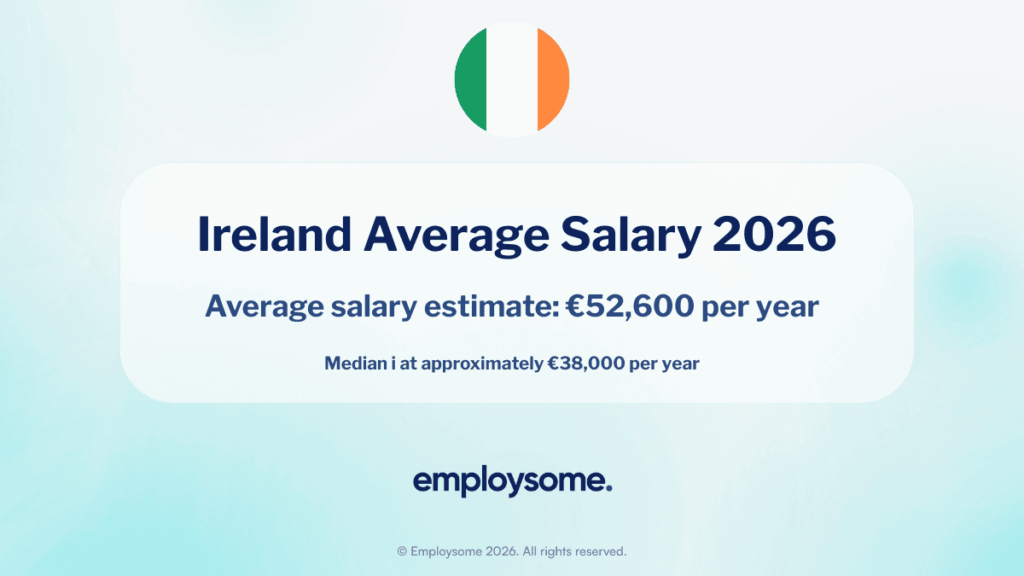
The average gross weekly earnings in Ireland reached €1,011.88 in Q4 2025 (CSO, published February 2026), equivalent to approximately €52,600 per year. The median is significantly lower at approximately €38,000 (€730.89/week, CSO EAADS 2024), reflecting Ireland’s ‘two-speed’ economy where multinational tech and pharma salaries pull the average far above what most workers actually earn. This guide covers national averages, sector breakdowns, how Dublin compares to the rest of Ireland, the gender pay gap, employer costs (PRSI, auto-enrolment pension), how Ireland compares to other European countries, and what these figures mean for companies hiring in the Irish market.


Average Salary in Ireland: National Overview
The Central Statistics Office (CSO) publishes quarterly earnings data through its Earnings and Labour Costs release, and annual distribution data through its Earnings Analysis using Administrative Data Sources (EAADS). The most recent quarterly data (Q4 2025, published 24 February 2026) shows:
|
Metric |
Amount |
|
Average gross weekly earnings (Q4 2025, CSO) |
€1,011.88 |
|
Annualised average gross salary (Q4 2025) |
~€52,600 |
|
Average hourly earnings (Q4 2025, CSO) |
€31.22 |
|
Median weekly earnings (EAADS 2024) |
€730.89 |
|
Annualised median salary (EAADS 2024) |
~€38,000 |
|
Mean weekly earnings (EAADS 2024) |
€942.73 |
|
Annualised mean salary (EAADS 2024) |
~€49,000 |
|
Average net monthly take-home (~€50k gross) |
~€3,300–€3,500 |
|
Minimum wage (2026, age 20+) |
€14.15/hour (~€29,400/year) |
Average weekly earnings grew by 3.1% year-on-year in Q4 2025, following stronger growth of 5.6% in Q1 2025. Over the three years to Q4 2025, average weekly earnings rose by 11.8% across all sectors. Average hourly earnings grew by 3.4% to €31.22. These are among the highest average earnings in the EU.
Unlike Spain or many other European countries, Ireland does not use a 13th or 14th month salary system. Salaries are typically paid monthly or fortnightly, and the gross annual figure is simply 12 times the monthly salary or 52 times the weekly salary.
 Employsome Insight: Ireland’s Average Is Heavily Skewed by Multinationals — The Median Is €14,000 Lower
Ireland has one of the widest gaps between mean and median earnings in Europe. The average (mean) annual salary of ~€49,000–53,000 is pulled dramatically upward by high earners in multinational tech companies (Google, Meta, Apple, Microsoft), pharmaceutical firms (Pfizer, Lilly, MSD), and financial services. The median of ~€38,000 is a far more accurate reflection of what most Irish workers actually earn. Almost two-thirds of all employees earn below the mean. For employers benchmarking compensation, the median is the more reliable starting point for most roles.
Average Salary by Sector
Ireland’s economy is frequently described as ‘two-speed’: a high-wage multinational sector (tech, pharma, finance) and a lower-wage domestic services sector (hospitality, retail, arts). The CSO data by sector for Q4 2025 illustrates this starkly:
|
Metric |
Amount |
|
Average gross weekly earnings (Q4 2025, CSO) |
€1,011.88 |
|
Annualised average gross salary (Q4 2025) |
~€52,600 |
|
Average hourly earnings (Q4 2025, CSO) |
€31.22 |
|
Median weekly earnings (EAADS 2024) |
€730.89 |
|
Annualised median salary (EAADS 2024) |
~€38,000 |
|
Mean weekly earnings (EAADS 2024) |
€942.73 |
|
Annualised mean salary (EAADS 2024) |
~€49,000 |
|
Average net monthly take-home (~€50k gross) |
~€3,300–€3,500 |
|
Minimum wage (2026, age 20+) |
€14.15/hour (~€29,400/year) |
Average weekly earnings grew by 3.1% year-on-year in Q4 2025, following stronger growth of 5.6% in Q1 2025. Over the three years to Q4 2025, average weekly earnings rose by 11.8% across all sectors. Average hourly earnings grew by 3.4% to €31.22. These are among the highest average earnings in the EU.
Unlike Spain or many other European countries, Ireland does not use a 13th or 14th month salary system. Salaries are typically paid monthly or fortnightly, and the gross annual figure is simply 12 times the monthly salary or 52 times the weekly salary.
Employsome Insight: Ireland’s ‘Two-Speed’ Economy Means Sector Matters More Than Country
If you are hiring a software engineer in Dublin, you are competing with Google, Meta, Stripe, and Salesforce for talent. Average tech salaries of €65,000–90,000+ reflect this competition. If you are hiring a customer service agent or a hospitality worker, the salary benchmark is closer to €25,000–35,000. Using the national average of €52,600 as a benchmark for either scenario would lead to either dramatic overpayment or a complete inability to attract candidates. Always benchmark against the specific sector.
Dublin vs. the Rest of Ireland
Dublin dominates Ireland’s salary landscape. As the headquarters for virtually all of Ireland’s multinational employers and the centre of the financial services industry, Dublin salaries are significantly higher than the national average. However, Dublin’s cost of living, particularly housing, is also dramatically higher.
- Dublin: Average salaries are approximately 15–25% above the national average, with tech and finance roles often 30–50% higher. A one-bedroom apartment in Dublin city centre costs €1,800–€2,200/month.
- Cork: Ireland’s second city has a growing tech and pharma presence (Apple, Pfizer, MSD). Salaries are typically 5–15% below Dublin levels, but housing costs are 30–40% lower.
- Galway: Strong medtech and life sciences cluster. Salaries are similar to Cork for specialist roles, with lower living costs.
- Limerick: Growing tech and manufacturing base. Salaries are 10–20% below Dublin, with significantly more affordable housing.
- Remote/regional: Outside the main cities, salaries can be 20–30% below Dublin levels, though many remote workers retain Dublin-benchmarked salaries from multinational employers.
The CSO does not publish earnings data by region in its quarterly release, but the EAADS 2024 publication provides regional breakdowns. Indian nationals had the highest median weekly earnings at €876.04, followed by UK nationals (€780.00) and Irish nationals (€762.72), reflecting the concentration of high-skill multinational roles filled by international workers.
Gender Pay Gap in Ireland
Ireland’s gender pay gap is narrower than many European peers but still significant. According to the most recent data (2022):
- Average hourly gender pay gap: 9.3%
- Median weekly earnings (EAADS 2024): Women €672.76 vs. overall median €730.89
Ireland’s Gender Pay Gap Information Act 2021 requires companies with 50+ employees to report their gender pay gap annually. The EU Pay Transparency Directive (transposition deadline June 2026) will add further requirements. Companies operating in Ireland should ensure their reporting systems are in place.
How Ireland’s Salaries Compare to Europe
|
Country |
Avg. Monthly Gross |
vs. Ireland |
|
Ireland |
~€4,400 |
— |
|
Germany |
~€4,250 |
-3% |
|
Netherlands |
~€3,800 |
-14% |
|
France |
~€3,750 |
-15% |
|
EU Average |
~€3,155 |
-28% |
|
Spain |
~€2,716 |
-38% |
|
Portugal |
~€1,700 |
-61% |
Ireland’s average salary is among the highest in the EU, comparable to Germany and above France and the Netherlands. However, Ireland is also the second most expensive country in Europe for goods and services (Eurostat 2025), which significantly erodes the purchasing power advantage. Housing costs in Dublin are particularly extreme, with rents rivalling or exceeding London levels. For employers, this means high gross salaries do not necessarily translate into high disposable income for employees, particularly in Dublin.
Employsome Insight: High Salaries, High Costs: Ireland’s Net Income Advantage Is Smaller Than It Looks
Ireland’s headline salaries look impressive versus the EU average, but the cost of living, particularly housing in Dublin, absorbs a significant portion. A €55,000 salary in Dublin provides roughly the same disposable income as a €40,000 salary in many Spanish or Portuguese cities. International companies should factor Dublin’s housing crisis into compensation packages; salary alone may not be sufficient to attract talent without additional benefits like relocation support or hybrid/remote work options.
What Salaries Really Cost Employers in Ireland
Ireland’s employer cost burden is lighter than most continental European countries, making it one of the more cost-efficient locations for hiring in Western Europe. The primary employer costs are:
Employer PRSI
The main employer contribution is Pay Related Social Insurance (PRSI). For most employees (Class A), the employer PRSI rate in 2026 is:
- 11.25% on weekly earnings above €441 (rising to 11.40% from 1 October 2026)
- 8.80% on weekly earnings of €441 or less (rising to 9.15% from 1 October 2026)
The employer PRSI rate includes a 1% National Training Fund Levy.
Auto-Enrolment Pension (‘My Future Fund’)
From 1 January 2026, Ireland’s new auto-enrolment retirement savings scheme requires employers to automatically enrol eligible employees who are not already in a pension scheme. Initial contributions are 1.5% of gross salary from both employer and employee, increasing gradually to 6% each over 10 years. The government provides a top-up of €1 for every €3 contributed by the employee.
Total Employer Cost Example
|
Cost Component |
Example (€55,000 gross/year) |
|
Gross annual salary |
€55,000 |
|
Employer PRSI (~11.25%) |
~€6,188 |
|
Auto-enrolment pension (1.5%) |
~€825 |
|
Total annual employer cost |
~€62,013 |
|
Total employer add-on (%) |
~12.75% above gross |
At approximately 12–13% above gross salary (rising as auto-enrolment contributions increase over the next decade), Ireland’s employer cost burden is significantly lower than Spain (~30–32%), France (~40–45%), or Germany (~20–21%). This makes Ireland one of the most cost-efficient locations for hiring in Western Europe on a total-employer-cost basis, despite the high headline salaries.
? Employsome Insight: Ireland’s Employer Costs Are Among the Lowest in Western Europe
At approximately 12–13% above gross salary, Ireland’s employer PRSI burden is dramatically lower than continental European peers. A €55,000 salary in Ireland costs the employer approximately €62,000 total. The same salary in Spain would cost approximately €72,000 (€55k + 30% social security), and in France approximately €77,000 (€55k + 40%). For international companies comparing total employment costs across European locations, Ireland’s low employer contribution rate partially offsets its higher headline salaries.
Factors That Affect Salary in Ireland
- Experience: Entry-level (0–2 years): €32,000–€38,000. Mid-level (3–7 years): €45,000–€55,000. Senior (8+ years): €60,000–€80,000+. Management and director-level roles in multinationals can exceed €100,000–€150,000.
- Sector: The single largest determinant. Tech and pharma roles pay 50–100% more than hospitality or retail for equivalent experience levels.
- Location: Dublin commands a 15–25% premium over the national average. Remote work is increasingly common, and some multinationals pay Dublin rates regardless of employee location.
- Multinational vs. domestic employer: MNC employees earn significantly more on average. Indian nationals (€876.04 median weekly) and UK nationals (€780.00) in Ireland earn above the national median, reflecting their concentration in high-skill MNC roles.
- Education: Degree-holders earn substantially more. Professional qualifications (ACCA, ACA, CIMA for accountants; engineering chartership) command premiums in regulated fields.
- Nationality: The CSO EAADS 2024 data shows significant earnings variation by nationality, driven by sectoral concentration. Ukrainian nationals had the lowest median weekly earnings (€498.77), reflecting concentration in lower-wage hospitality and services roles.
Salary Trends and 2026–2027 Outlook
- Wage growth moderating: After 5–6% annual growth through most of 2024–2025, Q4 2025 showed a slower 3.1% year-on-year increase. Growth is expected to continue at 3–4% in 2026, broadly in line with inflation.
- Minimum wage roadmap: The government is implementing a roadmap to a living wage of 60% of median earnings by 2026. The current minimum of €14.15/hour reflects step two of this process.
- Auto-enrolment impact: The ‘My Future Fund’ (January 2026) adds 1.5% to employer costs immediately, rising to 6% over 10 years. This is the single largest structural increase in employer costs in Ireland in decades.
- PRSI increases: Employer PRSI rises by 0.15% from October 2026, with further increases scheduled through 2028 to support the State Pension. These phased increases will gradually push Ireland’s employer cost ratio higher.
- Housing crisis and compensation pressure: Dublin’s housing shortage continues to drive demand for higher salaries, remote work options, and relocation benefits. Companies that cannot offer competitive housing solutions increasingly struggle to attract talent to Dublin.
- Tech sector cooling: After years of aggressive hiring and salary inflation, the tech sector has stabilised with more disciplined headcount growth. Tech salaries remain high but are no longer growing at the 10–15% rates seen in 2021–2022.
Final Takeaway – Average Salary in Ireland for Employers
Ireland’s average gross salary of approximately €49,000–53,000 (depending on the source and methodology) ranks among the highest in the EU. However, this headline figure is misleading for most hiring decisions because it is heavily skewed by multinational tech and pharma salaries. The median of approximately €38,000 is a more reliable benchmark for the typical Irish worker.
Ireland’s employer cost structure is one of its key competitive advantages. At approximately 12–13% above gross salary (PRSI + auto-enrolment), the total employer burden is significantly lower than continental European alternatives. This means that despite higher headline salaries, the total cost of employment in Ireland is often comparable to or lower than markets with lower gross salaries but much higher social security contributions.
For international companies, the critical factors are sector and location. A tech role in Dublin requires budgeting €65,000–90,000+ to be competitive, while a customer service or administrative role outside Dublin may be filled at €30,000–40,000. Always benchmark against the specific sector, city, and experience level rather than the national average.
For EOR provider comparisons in Ireland, see our Best Employer of Record in Ireland guide.

Written by
Dane Cobain is a Copywriter at Employsome and an accomplished author whose work spans fiction, non-fiction, and professional writing. Over the past decade, he has built a strong track record creating straightforward content for the HR, payroll, and corporate sectors. Dane brings a storyteller’s eye to the evolving world of global employment, with a particular focus on Employer of Record and PEO models. His articles explore industry trends and dedicated Best Of Guides when managing an international workforce.
Our content is created for informational purposes only and is not intended to provide any legal, tax, accounting, or financial advice. Please obtain separate advice from industry-specific professionals who may better understand your business’ needs. Read our Editorial Guidelines for further information on how our content is created.
Other posts
Check out other blog posts