Average Salary in South Africa 2026: What Employers Pay
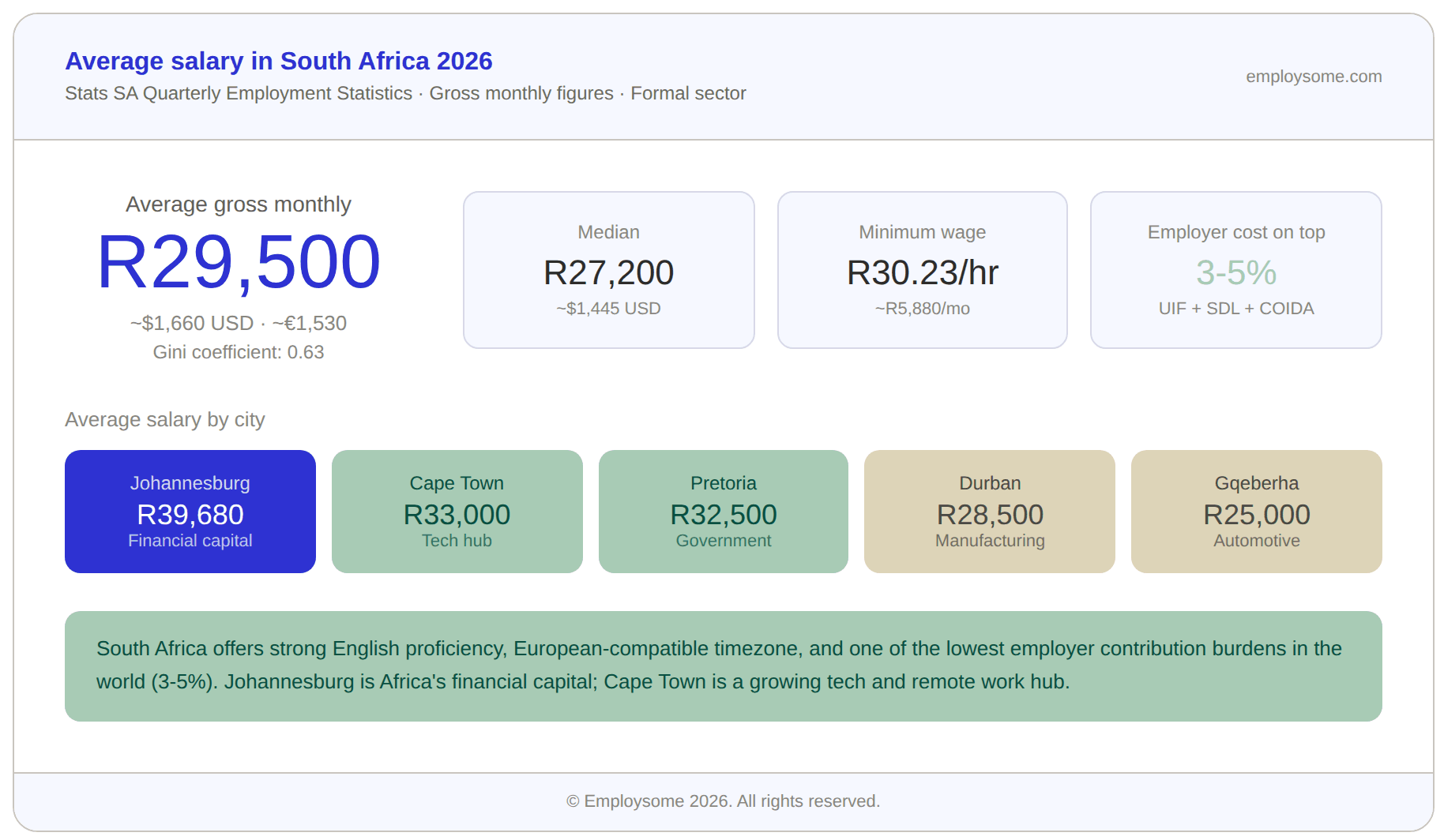
The average salary in South Africa is approximately R29,500 gross per month in 2026, based on Statistics South Africa’s Quarterly Employment Statistics. The median is significantly lower at approximately R27,200, reflecting one of the highest income inequality levels in the world (Gini coefficient ~0.63). The national minimum wage increased to R30.23 per hour from 1 March 2026. Employer costs add approximately 3-5% on top of gross salary through UIF (1%), SDL (1%), and Compensation Fund contributions, making South Africa one of the lowest employer-cost environments among major economies. This guide covers salaries by sector, city, and experience level, income tax brackets (18-45%), and how South Africa compares to other African and emerging markets.

Table of Contents
- Average Salary in South Africa by Sector
- Average Salary in South Africa by City
- Average Salary in South Africa by Experience Level
- Minimum Wage in South Africa 2026
- What Employers Actually Pay: Total Cost of Employment
- Income Tax in South Africa
- How the Average Salary in South Africa Compares
- Cost of Living Context
- What This Means for Companies Hiring Through an EOR
- FAQs
The average salary in South Africa is approximately R29,500 gross per month in 2026, based on data from Statistics South Africa’s Quarterly Employment Statistics (QES) survey. That is roughly $1,660 USD or €1,530. The median salary is approximately R27,200, significantly lower than the average, reflecting South Africa’s extreme income inequality. The country has a Gini coefficient of approximately 0.63, one of the highest in the world.
The gap between the average and median tells a critical story about the South African labour market. A small number of highly paid executives, professionals in financial services, mining, and tech pull the average upward, while a large proportion of the workforce earns at or close to the national minimum wage. For international employers setting salary benchmarks, the median is a more reliable reference point than the average.
The average salary in South Africa has been rising steadily but slowly. In Q1 2025, average monthly gross earnings in the formal non-agricultural sector were approximately R28,220, growing to R29,490 by Q3 2025. When adjusted for inflation, real wage growth has been modest, as South Africa’s consumer price index has risen significantly over the same period.
For international companies, South Africa offers a compelling hiring proposition: strong English proficiency, a deep professional talent pool (particularly in financial services, tech, and customer support), competitive salaries relative to output quality, and a timezone that overlaps with both European and parts of Asian business hours. Johannesburg and Cape Town in particular have established themselves as outsourcing and remote work hubs for UK- and EU-based companies.
But the average salary in South Africa only tells part of the employer cost story. South Africa has one of the lowest employer contribution burdens among major economies, with mandatory contributions adding approximately 3-5% on top of gross salary through UIF, SDL, and the Compensation Fund.
Hiring in South Africa?
South Africa offers strong English-speaking professional talent at competitive salaries, with one of the lowest employer contribution burdens in the world. If you are looking to hire in South Africa without setting up a local entity, an Employer of Record handles PAYE, UIF, SDL, Compensation Fund, and full compliance with the BCEA and Labour Relations Act. See our Best Employer of Record comparison for providers ranked on compliance execution and in-country infrastructure.

Average Salary in South Africa by Sector
Salaries in South Africa vary dramatically by industry. Financial services and mining consistently pay the highest wages, while retail, agriculture, and hospitality sit at the lower end. The following figures represent approximate gross monthly salaries for mid-level professionals in 2026, excluding bonuses.
|
Sector |
Average Gross Monthly Salary (ZAR) |
Approx. USD |
|
Mining & Resources |
45,000-85,000 |
$2,530-$4,780 |
|
Financial Services / Banking |
40,000-75,000 |
$2,250-$4,220 |
|
Software / IT |
38,000-70,000 |
$2,140-$3,940 |
|
Engineering |
35,000-60,000 |
$1,970-$3,370 |
|
Telecommunications |
32,000-55,000 |
$1,800-$3,090 |
|
Marketing / Communications |
28,000-50,000 |
$1,575-$2,810 |
|
Accounting / Audit |
28,000-48,000 |
$1,575-$2,700 |
|
Healthcare (private sector) |
30,000-55,000 |
$1,690-$3,090 |
|
Education |
22,000-38,000 |
$1,240-$2,140 |
|
Retail / Hospitality |
8,000-18,000 |
$450-$1,010 |
|
Agriculture |
6,000-14,000 |
$340-$790 |
The mining sector remains one of South Africa’s highest-paying industries, driven by demand for platinum, gold, and manganese. Financial services in Johannesburg (Africa’s financial capital) and the growing tech sector in Cape Town also command premium salaries. At the other end, retail, hospitality, and agriculture employ large numbers of workers at or near the minimum wage, which contributes heavily to the gap between the average and median salary figures.
Average Salary in South Africa by City
Location has a substantial impact on the average salary in South Africa. Gauteng province (home to Johannesburg and Pretoria) pays the highest salaries, followed by the Western Cape (Cape Town) and KwaZulu-Natal (Durban).
|
City/Province |
Average Gross Monthly Salary (ZAR) |
Notes |
|
Johannesburg (Gauteng) |
35,000-40,000 |
Financial centre, highest salaries |
|
Cape Town (Western Cape) |
30,000-36,000 |
Tech hub, growing remote work base |
|
Pretoria (Gauteng) |
30,000-35,000 |
Government and defence sector |
|
Durban (KwaZulu-Natal) |
25,000-32,000 |
Manufacturing and logistics |
|
Port Elizabeth / Gqeberha |
22,000-28,000 |
Automotive manufacturing |
|
Other provinces |
15,000-25,000 |
Lower cost of living, fewer formal jobs |
Johannesburg commands a clear salary premium as Africa’s largest financial centre and home to the Johannesburg Stock Exchange (JSE). Cape Town has emerged as a significant tech and startup hub, with a growing cluster of international remote workers and companies hiring South African developers and designers. The salary gap between Gauteng/Western Cape and the rest of the country is substantial, reflecting both the concentration of formal employment and the higher cost of living in major metros.
Average Salary in South Africa by Experience Level
Experience is a strong salary driver in South Africa, though the trajectory is steeper in professional sectors than in lower-skilled roles.
|
Experience Level |
Average Gross Monthly Salary (ZAR) |
Approx. USD |
|
Entry-level (0-2 years) |
10,000-20,000 |
$560-$1,125 |
|
Junior (2-5 years) |
18,000-30,000 |
$1,010-$1,690 |
|
Mid-level (5-10 years) |
30,000-50,000 |
$1,690-$2,810 |
|
Senior (10-15 years) |
45,000-80,000 |
$2,530-$4,500 |
|
Director / Executive (15+ years) |
75,000-200,000+ |
$4,220-$11,240+ |
Annual salary increases in South Africa average approximately 5-8% in nominal terms, though real increases (after inflation) are significantly lower. Some sources suggest employees receive an increment of approximately 8% every 18 months on average, though this varies widely by company and industry.
Minimum Wage in South Africa 2026
The national minimum wage in South Africa from 1 March 2026 is R30.23 per hour, a 5% increase from R28.79. For a full-time worker (45 hours per week), this translates to approximately R5,880 per month gross.
The minimum wage was introduced nationally in 2019 and has increased annually since. An exception applies to workers in the Expanded Public Works Programme (EPWP), who earn a lower rate of R16.62 per hour. Since 2022, domestic workers and farm workers receive the full national minimum wage rate, closing a previous gap.
Employers cannot count allowances such as transport, food, uniforms, accommodation, or other benefits toward the minimum wage. It must be paid as actual remuneration.
💡 Employsome Insight: South Africa’s minimum wage of ~R5,880/month is dramatically lower than the average salary of ~R29,500/month. This gap is wider than in most countries and reflects the structural inequality in the labour market. For international employers hiring professional roles, you should benchmark against the median (R27,200) or sector averages, not the minimum wage. Offering R15,000/month for a skilled role because “it’s above minimum wage” will not attract quality candidates.
What Employers Actually Pay: Total Cost of Employment
South Africa has one of the simplest and lowest employer contribution systems among major economies. Mandatory employer costs add approximately 3-5% on top of gross salary, compared to 14-19% in Taiwan, 20-30% in most European countries, or 30-40% in China.
UIF (Unemployment Insurance Fund): Total contribution is 2% of gross remuneration (1% employer, 1% employee), capped at R17,712/month. The employer’s maximum monthly contribution is R177.12. UIF covers unemployment, maternity leave, illness, and adoption leave.
SDL (Skills Development Levy): 1% of total payroll, paid entirely by the employer. Only applies if total annual payroll exceeds R500,000. Funds national education and training through Sector Education and Training Authorities (SETAs). Cannot be deducted from employee salaries.
Compensation Fund (COIDA): Employers must register with the Department of Labour’s Compensation Fund and pay an annual assessment based on employee earnings and industry risk classification. Rates vary by industry but typically range from 0.2% to 2% of payroll for most office-based and professional roles, higher for mining, construction, and manufacturing.
There is no employer pension contribution required by law. Many employers offer retirement fund contributions as a benefit, but this is voluntary, not statutory.
For an employee earning the national average of R29,500 gross per month, the approximate employer cost breakdown is: gross salary R29,500, UIF employer share R177.12 (capped), SDL R295, Compensation Fund ~R59 (assuming 0.2% for low-risk office work). Total employer cost: approximately R30,031 per month (~$1,690 USD). The employer burden is only ~1.8% above gross salary for a professional role, rising to 3-5% for higher-risk industries.
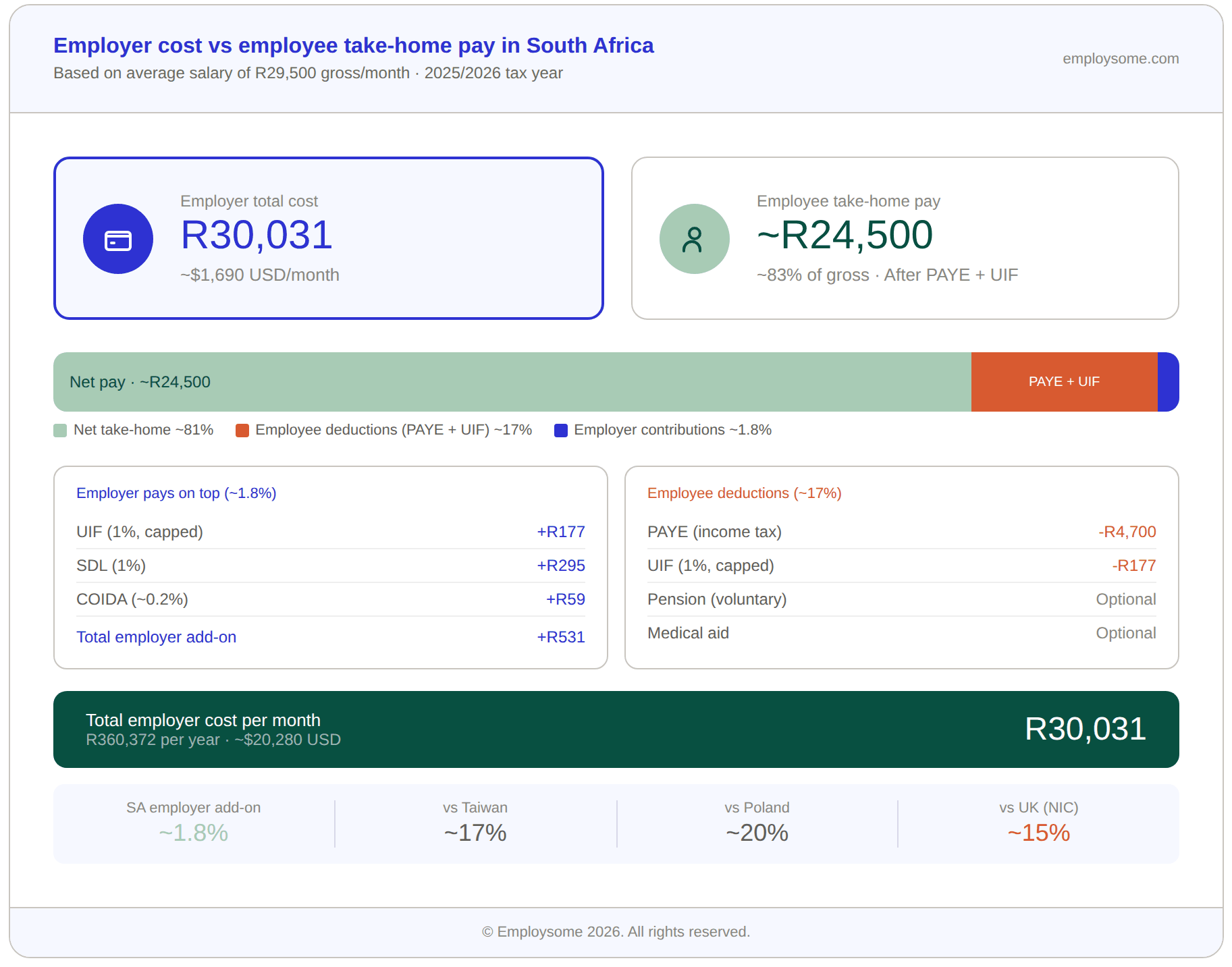
💡 Employsome Insight: South Africa’s low employer contribution burden is one of its strongest competitive advantages for international hiring. In many European countries, you would pay 25-40% on top of gross salary in social security and statutory contributions. In South Africa, the mandatory additions are minimal. This means more of your budget goes directly to the employee’s salary, which improves your ability to attract talent.
Income Tax in South Africa
South Africa operates a progressive PAYE (Pay As You Earn) system where employers withhold income tax monthly, unlike Taiwan where tax is filed annually. Tax rates for the 2025/2026 tax year (1 March 2025 to 28 February 2026) are:
|
Taxable Income (ZAR per year) |
Tax Rate |
|
0 – 237,100 |
18% |
|
237,101 – 370,500 |
26% |
|
370,501 – 512,800 |
31% |
|
512,801 – 673,000 |
36% |
|
673,001 – 857,900 |
39% |
|
857,901 – 1,817,000 |
41% |
|
Above 1,817,000 |
45% |
A primary rebate of R17,820 per year (R1,485/month) reduces the tax liability, meaning no tax is payable on the first approximately R95,750 of annual income for individuals under 65. Additional rebates apply for individuals aged 65-74 (R9,855) and 75+ (R3,292).
Retirement fund contributions (pension, provident, or retirement annuity) are tax-deductible up to 27.5% of the greater of remuneration or taxable income, capped at R350,000 per year. Medical aid tax credits are R376/month for the first two members and R254/month for each additional dependant.
For an employee earning the average salary of R29,500/month (R354,000/year), the effective PAYE rate after rebates is approximately 15-18%, resulting in take-home pay of roughly R24,000-25,000/month before UIF and any voluntary deductions.
How the Average Salary in South Africa Compares
|
Country |
Average Gross Monthly Salary |
Approx. USD |
Employer SI |
Min. Wage (Monthly) |
|
South Africa |
R29,500 (~$1,660) |
~$1,660 |
~3-5% |
R5,880 (~$330) |
|
Nigeria |
NGN 250,000 (~$155) |
~$155 |
~12-15% |
NGN 70,000 (~$44) |
|
Kenya |
KES 80,000 (~$610) |
~$610 |
~7-10% |
KES 15,201 (~$116) |
|
Egypt |
EGP 12,000 (~$240) |
~$240 |
~26% |
EGP 6,000 (~$120) |
|
Poland |
PLN 9,198 (~$2,300) |
~$2,300 |
~19-22% |
PLN 4,806 (~$1,200) |
|
India |
INR 40,000 (~$475) |
~$475 |
~12-15% |
Varies by state |
|
Philippines |
PHP 25,000 (~$440) |
~$440 |
~10% |
Varies by region |
|
UK |
GBP 3,000 (~$3,800) |
~$3,800 |
~15% NIC |
GBP 1,987 (~$2,520) |
South Africa occupies a unique position in the global hiring market. Salaries are substantially higher than most African and South Asian markets but significantly lower than European markets. The combination of strong English proficiency, professional workforce quality, European-compatible timezone, and very low employer contribution costs makes it an attractive option for companies hiring remote teams from Europe and the UK.
Compared to other African markets, South Africa pays significantly more but also offers deeper pools of experienced professionals, better infrastructure, and stronger legal frameworks for employment. The trade-off is a higher unemployment rate (~32%) and more complex labour law requirements.
Cost of Living Context
The average salary in South Africa must be understood alongside a cost of living that varies enormously between the major metros and the rest of the country. Monthly living costs for a single person (excluding rent) are approximately R8,000-12,000. Including rent, total monthly costs are approximately R15,000-22,000 in Johannesburg or Cape Town, R12,000-18,000 in Pretoria or Durban, and R8,000-14,000 in smaller cities.
An employee earning the average salary of R29,500/month can live comfortably in most South African cities. R30,000/month is generally considered a “good salary” that allows for a reasonable standard of living for a single person, including rent, transport, food, and some discretionary spending. Housing costs in Cape Town have risen substantially in recent years due to demand from remote workers and semi-gration from other provinces.
What This Means for Companies Hiring Through an EOR
For companies hiring in South Africa without a local entity, an Employer of Record handles all aspects of compliant employment: PAYE withholding and monthly SARS submissions via the EMP201 declaration, UIF registration and contributions (both employer and employee shares), SDL contributions (if payroll exceeds R500,000), Compensation Fund registration and annual assessment, employment contracts compliant with the Basic Conditions of Employment Act (BCEA) and the Labour Relations Act (LRA), and statutory leave administration.
South Africa’s labour law framework includes strong employee protections, particularly around unfair dismissal. The Labour Relations Act makes it difficult to terminate employees without following proper procedures, including notice periods, fair process, and potential CCMA (Commission for Conciliation, Mediation and Arbitration) referrals. An EOR with genuine South African employment expertise is essential for managing these risks.
Frequently Asked Questions
The average salary in South Africa is approximately R29,500 gross per month (~$1,660 USD). The median is approximately R27,200. Including all formal sector workers, salaries range from the minimum wage of approximately R5,880/month to over R200,000/month for senior executives.
R30.23 per hour from 1 March 2026, approximately R5,880 per month for a full-time worker (45 hours/week). EPWP workers earn R16.62 per hour.
Very little by international standards. UIF (1%, capped at R177.12/month), SDL (1% if payroll exceeds R500,000/year), and Compensation Fund (industry-dependent, typically 0.2-2%). Total employer burden is approximately 3-5% for most professional roles.
Progressive from 18% to 45%, withheld monthly via PAYE. After rebates, no tax is payable on the first ~R95,750 of annual income. The effective rate for average earners is approximately 15-18%.
Mining and resources (R45,000-85,000), financial services (R40,000-75,000), and software/IT (R38,000-70,000) consistently pay the highest salaries.
Yes. R30,000/month is slightly above the national average and provides a comfortable standard of living for a single person in most cities, including Johannesburg and Cape Town.
South Africa is significantly cheaper than European markets but more expensive than most African and South Asian markets. Its competitive advantages are English proficiency, professional workforce quality, European-compatible timezone, and very low employer contribution costs (3-5% vs 20-40% in Europe).
The gender pay gap in South Africa is between 23-35% at the monthly level, though it narrows significantly with higher education levels (as low as 5.9% among tertiary-educated workers).

Written by
Courtney Pocock is a Copywriter & EOR/PEO Researcher at Employsome with 15+ years of experience writing for the HR, corporate, and financial sectors. She has a strong interest in global business expansion and Employer of Record / PEO topics, focusing on news that matters to business owners and decision-makers. Courtney covers industry updates, regulatory changes, and practical guides to help leaders navigate international hiring with confidence.
Our content is created for informational purposes only and is not intended to provide any legal, tax, accounting, or financial advice. Please obtain separate advice from industry-specific professionals who may better understand your business’s needs. Read our Editorial Guidelines for further information on how our content is created.
Other posts
Review other blog posts