Minimum Wage in Poland: The Complete 2026 Guide
This guide breaks down Poland’s minimum wage system for 2026, covering the current statutory monthly and hourly rates, the distinction between employment contracts and civil law contracts, employer social security (ZUS) contributions, compliance requirements under the Polish Labour Code, penalties for underpayment, and how minimum wage in Poland compares to living costs across major Polish cities.

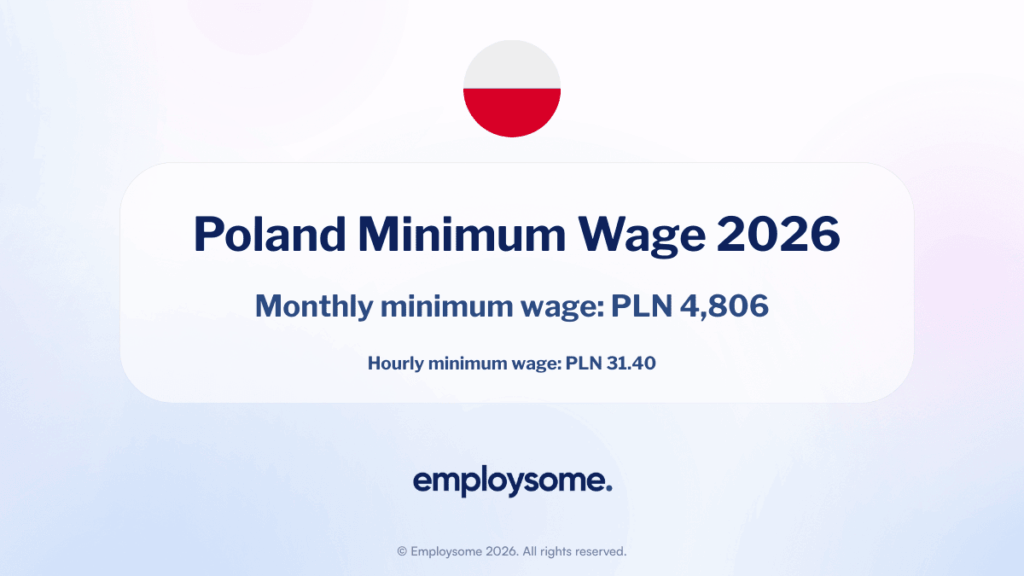
Table of Contents
- How Minimum Wage in Poland Is Regulated
- Current Rate
- Employment Contracts vs. Civil Law Contracts
- How Minimum Wage in Poland Is Calculated
- Employer Social Security Contributions in Poland (ZUS)
- Legal Framework
- Employer Obligations Under Polish Law
- Penalties for Violating Minimum Wage
- 2026-2027 Outlook
- Final Takeaway

How Minimum Wage in Poland Is Regulated
Poland’s minimum wage is governed by the Act on Minimum Remuneration for Work of 10 October 2002 (Ustawa o minimalnym wynagrodzeniu za pracę), which establishes the framework for setting and adjusting the statutory minimum wage nationwide. Unlike some EU countries that use sector-specific collective bargaining to determine wage floors, Poland applies a single national minimum wage that covers all employees regardless of region, industry, or occupation.
The rate is determined annually by the Council of Ministers (Rada Ministrów) following mandatory consultations with the Social Dialogue Council (Rada Dialogu Społecznego), a tripartite body comprising representatives from government, employer organisations, and trade unions. The Council evaluates:
- Projected consumer price inflation for the coming year
- GDP growth forecasts and labour productivity trends
- Labour market conditions, including unemployment rates and employment levels
- The ratio of minimum wage to projected national average wages (targeting at least 55% under the EU Adequate Minimum Wages Directive)
The final rate must be published by 15 September of the preceding year through a government regulation. In recent years (2023 and 2024), Poland introduced bi-annual adjustments, with increases taking effect in both January and July. For 2026, the government has returned to a single annual adjustment, with the rate remaining unchanged throughout the calendar year.
Official information on Poland’s minimum wage framework is published by the Ministry of Family, Labour and Social Policy (Ministerstwo Rodziny, Pracy i Polityki Społecznej).
Enforcement is overseen by the National Labour Inspectorate (Państwowa Inspekcja Pracy, PIP), which conducts workplace inspections, investigates complaints, audits payroll records, and pursues employers found to have underpaid workers. From 2026, PIP is expected to gain significantly expanded powers, including the ability to conduct remote inspections and to administratively reclassify civil law contracts as employment contracts where an employment relationship is found to exist in practice.
Poland Minimum Wage 2026: Current Rate
As of 1 January 2026, the minimum wage in Poland is:
|
Rate Type |
2026 Amount (Gross) |
|
Monthly minimum wage (employment contract) |
PLN 4,806 |
|
Hourly minimum rate (civil law contracts) |
PLN 31.40 |
This represents a 3% increase from the 2025 rate of PLN 4,666, and a PLN 140 gross increase per month. In euro terms, the 2026 minimum wage in Poland is approximately €1,139 per month (based on typical exchange rates in early 2026). In US dollar terms, it translates to roughly $1,340 per month.
Unlike 2023 and 2024, when the minimum wage was adjusted twice per year (in January and July), the 2026 rate will remain unchanged throughout the entire calendar year. This provides employers with greater payroll predictability for annual budgeting.
For context, here is how minimum wage in Poland has developed in recent years:
|
Year |
Monthly Gross (PLN) |
Hourly Gross (PLN) |
|
2020 |
2,600 |
17.00 |
|
2021 |
2,800 |
18.30 |
|
2022 |
3,010 |
19.70 |
|
2023 (Jan / Jul) |
3,490 / 3,600 |
22.80 / 23.50 |
|
2024 (Jan / Jul) |
4,242 / 4,300 |
27.70 / 28.10 |
|
2025 |
4,666 |
30.50 |
|
2026 |
4,806 |
31.40 |
The minimum wage in Poland has more than doubled since 2017 (when it stood at PLN 2,000), representing one of the most aggressive minimum wage growth trajectories in the European Union. Over the last five years alone, the minimum wage has increased by approximately 85%.
Employment Contracts vs. Civil Law Contracts
Understanding Poland’s minimum wage system requires distinguishing between two fundamentally different employment frameworks, each with its own minimum wage rules:
Employment contract (umowa o pracę): The standard employment relationship governed by the Polish Labour Code. The minimum wage of PLN 4,806 gross per month applies. Employees receive full statutory protections including paid annual leave (20-26 days), sick pay, notice periods, and employer-funded social security contributions.
Civil law contract – mandate contract (umowa zlecenie): A service contract governed by the Civil Code, not the Labour Code. The minimum hourly rate of PLN 31.40 gross applies. Workers on these contracts do not receive the same statutory protections as employees (no guaranteed paid leave, limited termination protections), but are covered by mandatory social security contributions.
Contract for specific work (umowa o dzieło): A results-based contract for a defined deliverable. No minimum wage or hourly rate applies. These contracts carry no ZUS social security obligations (other than ZUS notification requirements introduced in 2021). They are not covered by the Labour Code.
This dual-track system is a defining feature of Poland’s labour market. Historically, employers used civil law contracts to avoid higher employment costs, but regulatory enforcement has tightened significantly. From 2026, the National Labour Inspectorate (PIP) is expected to gain the power to administratively reclassify civil law contracts as employment contracts where the working relationship exhibits characteristics of employment (subordination, fixed workplace, set working hours). This reform, backed by the EU’s agenda for combating bogus self-employment, represents a major compliance risk for employers relying on civil law structures.
How Minimum Wage in Poland Is Calculated
The minimum wage in Poland applies to the total gross monthly remuneration for a full-time employee. When comparing an employee’s pay against the statutory minimum, most components of remuneration are included in the calculation, such as base salary, regular bonuses, and awards.
However, several important components are excluded from the minimum wage calculation:
- Jubilee (length-of-service) awards
- Severance pay on retirement or disability
- Night work allowances (calculated separately as 20% of the hourly rate derived from the minimum wage)
- Overtime premiums
For part-time employees, the minimum wage is prorated based on the fraction of full-time hours worked. A half-time employee’s minimum gross pay in 2026 would be PLN 2,403.
For workers on civil law contracts (umowa zlecenie), compliance is assessed on an hourly basis. The employer or commissioning party must ensure that pay does not fall below PLN 31.40 gross per hour, and is required to keep records of hours worked. Payment must be made at least monthly for contracts lasting longer than one month.
Employer Social Security Contributions in Poland (ZUS)
Beyond the minimum wage itself, employers in Poland must budget for mandatory social security contributions (ZUS), which significantly increase the total cost of employment. Contributions are calculated as a percentage of the employee’s gross salary and are split between employer and employee.
The employer’s share of ZUS contributions in 2026 includes:
- Pension insurance (emerytalne): 9.76% of gross salary (employer share)
- Disability insurance (rentowe): 6.50% of gross salary (employer share)
- Accident insurance (wypadkowe): 0.67% to 3.33% depending on industry risk profile (1.67% for employers with up to 9 insured persons)
- Labour Fund (Fundusz Pracy): 2.45% of gross salary
- Guaranteed Employee Benefits Fund (FGSP): 0.10% of gross salary
In total, employer-side contributions typically range from 19.21% to 22.41% of the employee’s gross salary, depending on the accident insurance rate applicable to the employer’s industry.
For a minimum wage employee in 2026 (PLN 4,806 gross), the total employer cost of employment, after adding mandatory ZUS contributions, exceeds approximately PLN 5,800 per month. This represents a cost premium of over 20% above the gross salary figure.
Employees also contribute 13.71% of gross salary toward social security (pension, disability, and sickness insurance), plus 9% of the post-contribution base toward health insurance. The net take-home pay for a full-time minimum wage employee in 2026 is approximately PLN 3,500-3,600 per month, depending on individual tax reliefs and deductions. Workers under 26 years old are exempt from income tax (PIT), increasing their net pay to approximately PLN 3,666.
Employers must register new employees with ZUS within 7 days of the start of employment and submit monthly contribution declarations (DRA forms) and individual reports (RCA, RSA, RZA forms) by the 15th of the following month.
Legal Framework Governing Minimum Wage in Poland
The principal legislation governing minimum wage in Poland includes:
- Act on Minimum Remuneration for Work (2002): Establishes the framework for setting the minimum wage rate, the annual review process, and the role of the Social Dialogue Council.
- Polish Labour Code (Kodeks pracy): Defines the employment relationship, working time rules, employee protections, and employer obligations. Minimum wage requirements for employment contracts derive from this code.
- Civil Code (Kodeks cywilny): Governs civil law contracts (umowa zlecenie, umowa o dzieło). The minimum hourly rate for mandate contracts is set by the Minimum Remuneration Act but the contractual framework sits under civil law.
- Act on the Social Insurance System (1998): Establishes the ZUS framework, employer contribution obligations, and reporting requirements.
- EU Directive 2022/2041 on Adequate Minimum Wages: Requires Poland to ensure that minimum wage constitutes at least 55% of the national average wage and introduces enhanced transparency requirements. Full implementation is expected by 2026.
Minimum wage protections cannot be waived by contract. If an employment agreement specifies pay below the statutory minimum, the legal rate prevails automatically. Any contractual provision setting compensation below the minimum wage is void under Article 18 of the Labour Code.
Employer Obligations Under Polish Law
To remain compliant with minimum wage in Poland rules, employers must:
- Pay at least PLN 4,806 gross per month for full-time employees on employment contracts (umowa o pracę), effective from 1 January 2026
- Pay at least PLN 31.40 gross per hour for workers on civil law mandate contracts (umowa zlecenie)
- Record working hours accurately for all workers on hourly-rate contracts and retain records for compliance verification
- Register employees with ZUS within 7 days of the start of employment and submit monthly contribution declarations by the 15th of the following month
- Issue written employment contracts that clearly define compensation, job position, place of work, working time, and start date. Any amendment requires written form
- Calculate night work allowances correctly: Night work premiums are calculated as 20% of the hourly rate derived from the minimum wage, so any increase in minimum wage in Poland automatically increases night shift costs
- Withhold and remit income tax (PIT): Progressive rates of 12% (up to PLN 120,000 annual income) and 32% (above PLN 120,000), with a tax-free allowance of PLN 30,000
- Update payroll systems promptly when annual rate changes take effect. The minimum wage in Poland also affects numerous statutory thresholds, including severance pay caps, sick pay calculations, and various allowances
For international companies without a legal entity in Poland, an Employer of Record (EOR) can handle all of these obligations on your behalf, including compliant employment contracts, payroll processing, ZUS registration and contributions, PIT withholding, and ongoing minimum wage compliance. The EOR acts as the legal employer in Poland, assuming full responsibility for labour law compliance while you retain day-to-day management of the employee. For a detailed comparison of providers, see our Best Employer of Record in Poland guide, which reviews pricing, entity ownership, and service quality across the leading EOR providers operating in the Polish market.
Penalties for Violating Minimum Wage in Poland
Minimum wage enforcement in Poland is handled by the National Labour Inspectorate (PIP), which conducts both planned inspections and complaint-driven investigations. PIP has the authority to audit payroll records, interview employees, and issue binding decisions requiring employers to remedy violations.
If an employer pays below the minimum wage in Poland, the consequences include:
- Administrative fines of PLN 1,000 to PLN 30,000: PIP can impose fines for violations of labour law provisions, including underpayment of the minimum wage. Repeat violations or obstruction of inspections can result in fines at the upper end of the range.
- Back-payment orders: Employers must pay arrears for any underpayment, covering the full difference between what was paid and the statutory minimum for each affected pay period.
- Criminal liability: Under Article 218 of the Polish Criminal Code, persistent and malicious violation of employee rights, including systematic underpayment, can result in fines, restriction of liberty, or imprisonment of up to two years.
- ZUS reclassification risk: If civil law contracts are reclassified as employment contracts (a risk that grows substantially from 2026 under expanded PIP powers), employers face retroactive ZUS contributions, back taxes, and penalties with interest.
- Employment tribunal claims: Employees can bring claims to labour courts for unpaid wages, with compensation of not less than the minimum wage for violations of equal treatment principles.
PIP is one of the more active labour inspectorates in Europe, conducting tens of thousands of inspections annually. The expansion of PIP’s powers in 2026, including the ability to reclassify contracts administratively and to conduct remote inspections, significantly increases compliance risk for employers operating in Poland.
Minimum Wage Poland vs. Cost of Living
Poland applies a single nationwide minimum wage of PLN 4,806 gross per month as of 1 January 2026, with no regional variation. However, the real purchasing power of minimum wage earnings varies significantly depending on where you live, primarily driven by differences in housing costs between major cities and smaller regional centres.
For a full-time minimum wage employee, net take-home pay is approximately PLN 3,500-3,600 per month (or roughly PLN 3,666 for workers under 26 exempt from PIT). The variation depends on individual tax reliefs, number of dependents, and whether the employee is under 26.
The real difference in purchasing power comes from the cost of living, particularly rent. Here is how minimum wage net income compares to average one-bedroom apartment rents across major Polish cities:
|
City |
Region |
Est. Net Pay |
Avg. 1-BR Rent |
Rent ÷ Income |
|
Warsaw |
Mazowieckie |
~PLN 3,550 |
~PLN 3,200 |
~90% |
|
Kraków |
Małopolskie |
~PLN 3,550 |
~PLN 2,600 |
~73% |
|
Wrocław |
Dolnośląskie |
~PLN 3,550 |
~PLN 2,500 |
~70% |
|
Gdańsk |
Pomorskie |
~PLN 3,550 |
~PLN 2,500 |
~70% |
|
Poznań |
Wielkopolskie |
~PLN 3,550 |
~PLN 2,300 |
~65% |
|
Katowice |
Śląskie |
~PLN 3,550 |
~PLN 1,800 |
~51% |
|
Lublin |
Lubelskie |
~PLN 3,550 |
~PLN 1,700 |
~48% |
|
Łódź |
Łódzkie |
~PLN 3,550 |
~PLN 1,600 |
~45% |
In Warsaw, a full-time minimum wage worker would spend approximately 90% of their net income on a one-bedroom apartment alone, leaving almost nothing for food, transport, and other essentials. This makes independent living on the minimum wage in Poland’s capital functionally unviable without shared housing or additional income sources. By contrast, in smaller cities such as Łódź, Lublin, or Katowice, the same statutory wage goes considerably further, with rent-to-income ratios of 45-51%.
This highlights an important structural feature of minimum wage in Poland: while the statutory wage floor is uniform across the country, real purchasing power varies materially depending on the city and local housing market conditions. Poland’s rapid rent growth in major cities (driven by urbanisation, university enrolment, and migration inflows) has significantly eroded the purchasing power of minimum wage earners in Warsaw, Kraków, and Wrocław in particular.
Minimum Wage Poland 2026-2027 Outlook
The minimum wage in Poland has followed an aggressive upward trajectory in recent years, more than doubling from PLN 2,000 in 2017 to PLN 4,806 in 2026. However, the 3% increase for 2026 (PLN 140) is notably smaller than the increases seen in 2023 (PLN 590 across two adjustments) and 2024 (PLN 366). This moderation reflects lower projected inflation and a government balancing act between worker purchasing power and employer cost pressures, particularly on SMEs.
Looking ahead, several policy developments will shape minimum wage in Poland in 2027 and beyond:
- EU Adequate Minimum Wages Directive (2022/2041): Requires the minimum wage to constitute at least 55% of the national average wage. Poland is expected to align with this target through the 2026 implementation process. With the projected average salary at approximately PLN 9,420 in 2026, 55% would imply a minimum wage floor of around PLN 5,181, suggesting continued upward pressure in coming years.
- Exclusion of bonuses from minimum wage calculations: Under the EU directive implementation, bonuses, incentives, and awards are expected to be excluded from the minimum wage base. This would effectively require many employers to increase base pay to maintain compliance, even without a headline rate increase.
- Expanded PIP enforcement powers: The National Labour Inspectorate’s new ability to reclassify civil law contracts as employment contracts will reshape compliance risk for employers. Companies using mandate contracts (umowa zlecenie) or B2B structures should audit their working arrangements.
- Pay transparency requirements: From December 2025, employers must disclose salary ranges in job advertisements. Full implementation of the EU Pay Transparency Directive by June 2026 will introduce mandatory gender pay gap reporting for companies with 250+ employees, with broader coverage in subsequent years.
For companies operating in Poland, closely monitoring government announcements and Social Dialogue Council discussions remains essential. Payroll systems must be updated promptly when rate adjustments take effect, as minimum wage in Poland also serves as the calculation base for numerous statutory thresholds, including night work allowances, sick pay, severance caps, and certain ZUS contribution limits. Failure to update all dependent calculations can create compliance exposure even when the headline wage rate is correctly applied.
Final Takeaway – Minimum Wage Compliance in Poland
Minimum wage in Poland operates under a single national statutory framework with a growing enforcement apparatus and clearly defined legal obligations. The rate applies uniformly across all regions and industries, covering both monthly employment contracts and hourly civil law contracts, making wage compliance a central payroll responsibility for any employer operating in the Polish market.
To remain compliant with minimum wage in Poland in 2026 and beyond, employers must ensure that full-time employees on employment contracts receive at least PLN 4,806 gross per month, and that workers on civil law mandate contracts receive at least PLN 31.40 gross per hour. Employer ZUS contributions, which add more than 20% to gross salary costs, must be budgeted separately. Working time records for hourly-rate contracts must be maintained accurately, and all payroll-dependent statutory thresholds (night work premiums, sick pay bases, severance limits) must be updated when the minimum wage changes.
Enforcement is active and expanding. The National Labour Inspectorate conducts thousands of inspections annually, with expanded powers from 2026 including remote inspections and administrative contract reclassification. Non-compliance can result in fines of up to PLN 30,000, back-payment orders, criminal prosecution for persistent violations, and retroactive ZUS liabilities where civil law contracts are reclassified as employment. For international companies hiring in Poland, whether directly or through an Employer of Record, minimum wage compliance should be treated as a core element of employment risk management. Proper wage compliance forms the foundation of lawful hiring, payroll stability, and long-term operational security in the Polish market.

Written by
Courtney Pocock is a Copywriter & EOR/PEO Researcher at Employsome with 15+ years of experience writing for the HR, corporate, and financial sectors. She has a strong interest in global business expansion and Employer of Record / PEO topics, focusing on news that matters to business owners and decision-makers. Courtney covers industry updates, regulatory changes, and practical guides to help leaders navigate international hiring with confidence.
Our content is created for informational purposes only and is not intended to provide any legal, tax, accounting, or financial advice. Please obtain separate advice from industry-specific professionals who may better understand your business’s needs. Read our Editorial Guidelines for further information on how our content is created.
Other posts
Along with our standard maps we offer highly customizable maps.