
Papaya Global EOR Expert Review [2026]: Still Any Good?
Papaya Global is a global EOR and workforce payment platform that offers its EOR services solely through a third-party network.


Papaya Global is an Israeli payroll and workforce payments unicorn with a platform designed for mid-market and enterprise teams managing teams across multiple countries at scale. Our Papaya Global review benchmarks the provider against 130+ EOR platforms in our database, covering pricing, services, country coverage, platform technology, contract terms, and the partner-based EOR delivery model. This independent Papaya Global review scores the provider 3.9 out of 5 overall, with standout strength in platform technology and integrations and watch-outs around pricing transparency and partner-dependent execution.
Papaya Global is an Israeli payroll and workforce payments unicorn built for mid-market and enterprise teams managing complex, multi-country payroll. Strong platform technology and proprietary payment infrastructure, delivered through a partner-based EOR model.
As part of our independent EOR reviews at Employsome, we evaluate Papaya Global using our data-driven editorial scoring framework, which combines global EOR capabilities with verified country-level execution to reflect real-world compliance and delivery quality. This Papaya Global review is built on procurement-stage testing, direct vendor evaluation, verified G2 and Capterra cross-reference, and benchmarking against 130+ Employer of Record providers in our database.
In this expert Papaya Global EOR review, we analyse Papaya’s pricing, contract terms, platform features, compliance reliability, and on-the-ground operations to assess how it performs against other leading Employer of Record providers like Deel, Remote, and Multiplier. Papaya Global sits in our upper-mid tier on overall capability, with category-leading platform technology offset by a partner-based EOR delivery model and enterprise-tier pricing that procurement teams should plan for upfront.
Our complete Papaya Global review covers the full evaluation: scoring breakdown across six categories, Papaya services overview, country coverage analysis across 100+ markets, transparent Papaya pricing with watch-out fees, balanced pros and cons, and a final buyer recommendation. We also benchmark Papaya against the top EOR platforms in our Best Employer of Record comparison, where you can review country-specific scores, pricing differences, and provider rankings across global markets.
Best for global payroll consolidation, not best for first-time international hires
Papaya Global shines for finance and HR teams that need to consolidate payroll across 10+ countries into a single platform with proprietary payment rails and enterprise-grade analytics. For companies hiring their first one or two international employees, the platform’s depth, pricing (~$650-770 EOR per employee plus 1-2 months security deposit), and mandatory sales-led onboarding will feel heavier than necessary versus more self-serve providers.

How Papaya Global Scores: Our Data-Driven Analysis
Our 2026 Papaya Global scoring is based on Employsome’s six-factor evaluation framework, combining direct vendor evaluation, verified user reviews, country-level execution checks, and procurement-stage testing. Each category in the Papaya Global review is independently weighted and benchmarked against the EOR category average across 130+ Employer of Record providers we have evaluated.
Papaya Global’s aggregate score of 3.9 out of 5 reflects a provider that performs strongly on platform technology and global coverage but is held back by enterprise-tier pricing and the variability inherent in a partner-based EOR delivery model. Standout performance sits in platform and integrations (4.5), with consistent good scores across global coverage (4.0), customer experience (4.0), and payment terms (4.0). The pricing and transparency category (3.0) is the main area of concern in this Papaya Global review and the most important watch-out for procurement teams.
Global Coverage & Services
Papaya provides broad geographic coverage through a vetted network of in-country partners (ICPs), with notable strength in regulatory-complex markets where local specialists outperform centralised owned-entity models.
Pricing & Transparency
Papaya sits at the enterprise tier of the EOR market on pricing. Headline rate is materially higher than Deel, Remote, or Multiplier, and mandatory security deposits create significant upfront cash flow pressure.
Payment & Contract Terms
Contract terms are clean on duration (30-day notice for convenience) but cash-flow heavy on operations. Full pre-funding requirement plus mandatory deposits means procurement teams should size working capital exposure carefully.
Customer Experience & Support
Customer support is structurally good with dedicated account management, but the partner-based model introduces escalation friction in cases where the local partner is the operational owner.
Platform & Integrations
Platform and integrations is Papaya’s strongest category and the primary reason the overall 3.9 score lands where it does. Payroll engine, payments infrastructure, and integration depth are best-in-class.
Key Features & Services of Papaya Global
Papaya Global offers a comprehensive workforce solution covering global payroll (its flagship product), Employer of Record via in-country partners, contractor management, proprietary global workforce payments, and workforce intelligence analytics. This breadth of Papaya Global services consolidates global payroll and compliance needs under a single platform, with particular strength for finance teams that need consolidated reporting across multiple countries.
For most buyers, Papaya Global’s primary value sits in the global payroll engine and payments infrastructure, with EOR delivered as a layer on top via vetted in-country partners (ICPs). The contractor management and workforce intelligence products extend the platform into adjacent workflows for mid-market and enterprise teams.
Global Payroll
Centralised payroll for 100+ countries with unified dashboard, automated tax and contribution calculations, AI-driven anomaly detection, and country-specific compliance monitoring. Replaces dozens of local vendors with a single automated platform.
Employer of Record (via ICPs)
EOR delivered through vetted local in-country partners (ICPs) as the legal employer. Includes compliant contracts, automated onboarding, local payroll and statutory payments, benefits administration, IP and confidentiality agreements, and termination support with local legal review.
Global Contractor Management
Unified system for onboarding, paying, and managing freelancers across borders. Contract templates, global payment processing, mass payouts, automated invoicing, compliance checks, and misclassification insights.
Global Workforce Payments
Papaya’s own payroll payments infrastructure (not third-party processors) enables fast global salary disbursements with FX optimisation and real-time tracking from funding to employee payout. Mass payments to 160+ destinations triggered in one click.
Workforce Intelligence
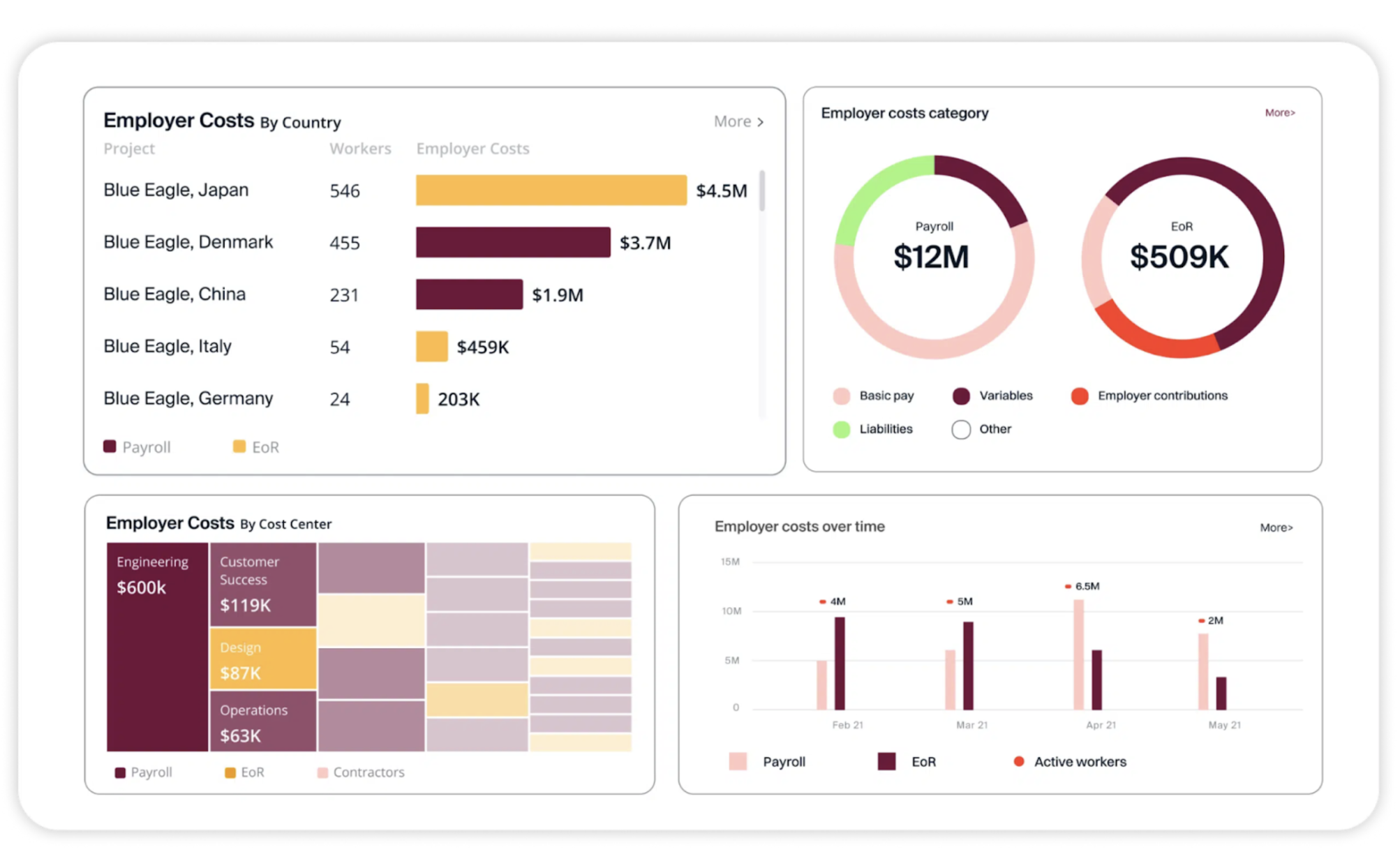
Real-time analytics dashboard converting raw payroll data into actionable insights: employer cost modelling, variance monitoring, and global compensation planning across all countries.
Onboarding, payroll, and workflow execution
Papaya’s platform is designed for mid-market and enterprise teams managing multiple countries at scale, built around automation, workforce analytics, and payroll accuracy. Unlike most competitors there is no self-serve sign-up: every customer journey starts with a sales call. Once onboarded, account managers are assigned to every customer.
Onboarding options. Contractors and employees can be onboarded via bulk template upload, direct manual entry through a dashboard, or VMS integration that imports contractor data automatically. A centralised dashboard shows contractor status (active, invited, pending), country, currency, and payment group. Onboarded workers receive platform access to manage their own personal data, bank details, payment preferences, and tax information.
Org chart configuration. Papaya supports complex admin structures with multi-level reporting and department tagging. The org chart drives access controls: who can see whose payroll, who can approve whose expense or leave request. Important for enterprise teams with hierarchical approval flows.
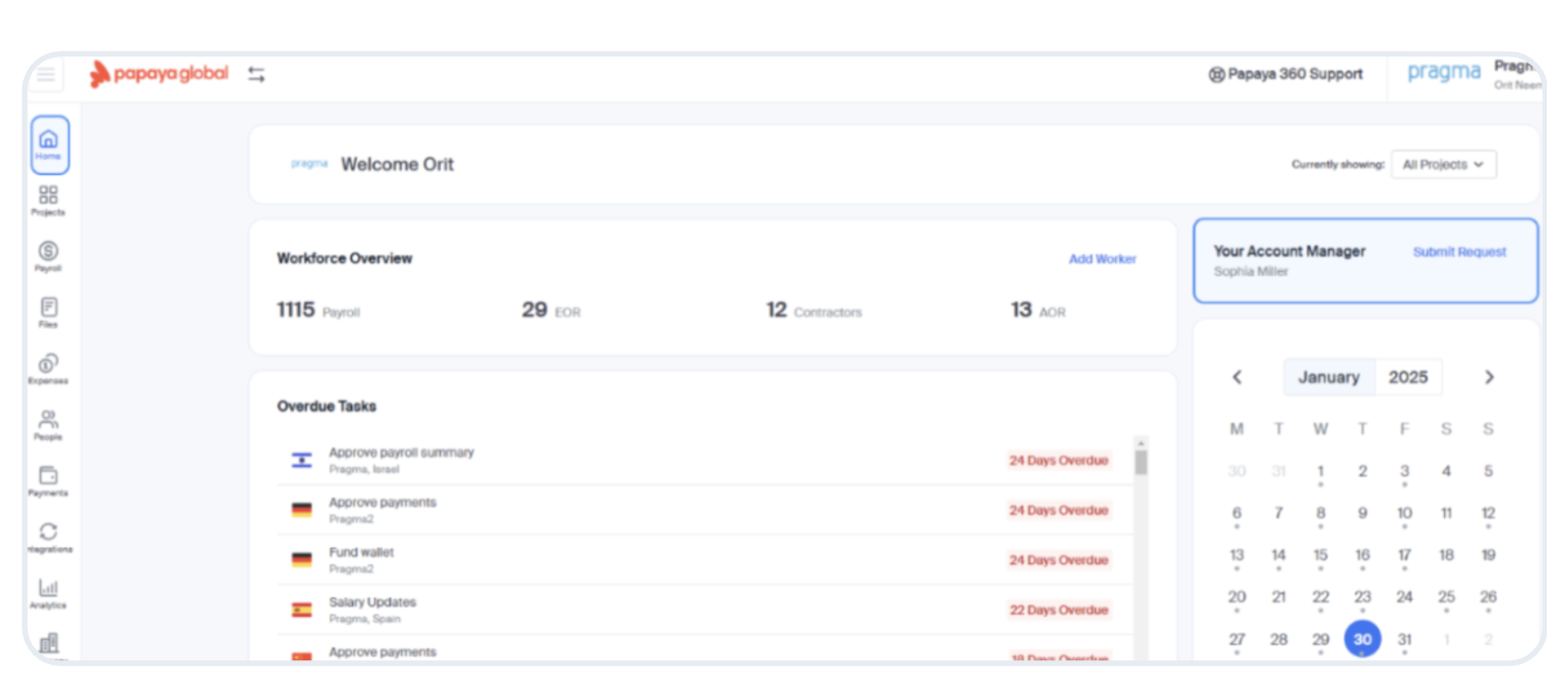
Payments, payroll, and invoicing. Papaya uses a multi-currency wallet model rather than per-invoice charges. Customers pre-fund digital wallets in each invoicing currency; corrections from previous payroll cycles are added back to the wallet for the next cycle. The wallet displays missing funds required for the next payment cycle. Approvals happen in a Payment Management dashboard with filters for project, pay period, and status, with bulk approval support. Funds must clear at least 3 days before the scheduled payout date.
Payroll analytics. A detailed analytics dashboard provides transparency on payroll, EOR, and contractor costs. Filter and monitor by country, department, employer cost fluctuation, and trend. The forecasting feature lets finance teams plan upcoming payroll expenses.
Papaya Global Country Coverage: Partner-Based EOR Model
How a provider builds its global presence makes a significant difference in employee experience, compliance reliability, and long-term cost. Papaya Global operates primarily through a partner-based EOR model, using vetted in-country partners (ICPs) as the legal employer in each market rather than establishing owned legal entities. Papaya has publicly defended this approach in CEO commentary, arguing that local specialists out-perform centralised owned entities in many markets (read their CEO’s memo here).
In practice, Papaya Global audits its partners against compliance and service standards, applies Papaya-standardised employment contracts even when the local partner is the legal employer, and provides a single global interface and escalation path. The breakdown below summarises the trade-offs of the partner-based model relative to the owned-entity approach used by Deel, Remote, Oyster HR, and Multiplier.
The partner model is a feature, not a bug, for complex markets
Papaya’s public position is that local specialists in markets like Brazil, India, Nigeria, and Indonesia outperform centralised owned-entity teams. In our procurement testing this argument holds up: ICPs already have the legal infrastructure, payroll calendars, and cultural fluency that owned entities take 12-24 months to build organically. The trade-off is on consistency and escalation speed in routine markets where owned-entity providers (Deel, Remote, Multiplier) are smoother.
Papaya Global Pricing Overview
Papaya Global pricing sits at the enterprise tier of the EOR market. Indicative EOR pricing ranges from approximately $650 to $770 per employee per month depending on country and partner, with global payroll and contractor management priced separately. Papaya publishes high-level pricing ranges on its website and the sales team provides accurate quotes during the procurement cycle.
Compared with other EOR pricing in the market, Papaya Global sits at the top end on headline rates: meaningfully more expensive than Deel, Remote, or Multiplier on base EOR fees, with additional cost from mandatory security deposits (typically 1-2 months of gross salary per employee), FX margins on cross-currency payroll, and partner fees that vary by country. The Papaya cost watch-outs below detail the additional fees that buyers should factor into total cost of ownership.
Total cost of ownership matters more than headline price
For a 10-employee Papaya EOR deployment at $650-770 each plus 1-2 month deposits, the year-one cash outlay sits at $130K-$240K depending on country and salary mix. By contrast, Deel or Multiplier on similar coverage would run $70K-$110K without the deposit overhang. Papaya’s value case rests on the payroll engine and integrations being worth the premium for finance teams that need consolidated multi-country reporting; for simpler hiring profiles, the math typically favours an owned-entity competitor.
Who Is Papaya Global Best For?
Papaya Global is the right fit for mid-market and enterprise companies managing complex, multi-country payroll and EOR operations, where platform depth, consolidated reporting, and enterprise governance matter more than the lowest possible price point. The buyer-fit breakdown below maps where Papaya excels across seven procurement dimensions, based on our independent Papaya Global review rather than marketing positioning. Use this to quickly confirm Papaya is the right match for your hiring profile, company stage, and operational priorities.
Papaya Global Pros & Cons
Every EOR provider has trade-offs, and this Papaya Global review aims to surface them honestly. The balanced view below summarises Papaya’s four most significant strengths against four areas worth scrutinising during procurement. Each item reflects our direct evaluation experience and verified user feedback rather than vendor marketing.
Strengths
- Exceptional payroll accuracy. One of the strongest global payroll engines in the industry, built for multi-country operations at scale.
- Deep integrations. Best-in-class HRIS and ERP connectors (Workday, SAP, NetSuite, BambooHR) plus seven specialised automation connectors.
- Advanced payments infrastructure. Proprietary global payment rails with fast payouts, strong FX transparency, and J.P. Morgan backing.
- Enterprise-grade compliance. Robust controls, anomaly detection, and strong reporting for HR and finance teams. SOC2 Type II and ISO27001 certified.
Watch-outs
- Higher pricing. EOR and payroll fees sit at the top end of the market: ~$650-770 per EOR employee per month.
- Reliance on in-country partners. Can result in slower onboarding, less direct support escalation, and reduced contract flexibility.
- Deposits and pre-funding required. 1-2 months gross salary deposit per employee creates cash flow pressure on first-year deployments.
- No misclassification insurance. Less protection for hiring contractors globally compared with Deel and Remote, which include misclassification cover by default.
Based on this independent Papaya Global review, Papaya is an excellent choice for mid-market and enterprise companies building global payment infrastructure with deep integrations into native HRIS, ERP, and finance systems. The platform technology, proprietary payment rails (backed by J.P. Morgan), and consolidated multi-country analytics are best-in-class. For finance teams that need to consolidate payroll across 10+ countries into a single interface, Papaya is one of the strongest providers on the market.
Our Papaya Global review scored the provider 3.9 out of 5, placing it in the 72nd percentile of 130+ EOR providers we have evaluated. Papaya scored Very Good (4.5) on Platform & Integrations and Good (4.0) across Coverage, Payment Terms, and Customer Support. The category holding the aggregate back is Pricing & Transparency (3.0, Limited), reflecting top-of-market headline rates and mandatory 1-2 month security deposits per employee. For startups and SMBs running first international hires, the math typically favours Deel, Remote, or Multiplier; for mid-market and enterprise teams with multi-country payroll needs, Papaya’s platform depth justifies the premium.
- Mid-market and enterprise teams (50+ international hires)
- Multi-country payroll consolidation (10+ markets)
- Finance teams needing deep ERP and HRIS integration
- Complex markets: LATAM, APAC, Africa
- Negotiate or cap the security deposit (1-2 months gross salary)
- Confirm partner identity and audit history per country
- Lock FX margin contractually on cross-currency payroll
- Verify benefits delivery in target countries with local partner
Powerful enterprise payroll platform with a partner-based EOR trade-off. The right pick for mid-market and enterprise teams that need consolidated multi-country payroll and deep integrations, where platform depth is worth the enterprise pricing. Not the right pick for startups or SMBs hiring their first one or two international employees.
Compare Papaya Global with other top EOR providers




Dane Cobain is a Copywriter at Employsome and an accomplished author whose work spans fiction, non-fiction, and professional writing. Over the past decade, he has built a strong track record creating straightforward content for the HR, payroll, and corporate sectors. Dane brings a storyteller’s eye to the evolving world of global employment, with a particular focus on Employer of Record and PEO models. His articles explore industry trends and dedicated Best Of Guides when managing an international workforce.
Our content is created for informational purposes only and is not intended to provide any legal, tax, accounting, or financial advice. Please obtain separate advice from industry-specific professionals who may better understand your business’s needs. Read our Editorial Guidelines for further information on how our content is created.