
Remote.com EOR Review (2026) – Features, Pricing & Verdict
Remote is one of the largest global EOR companies and focuses predominantly on the European market.


In this expert Remote EOR review, we analyse one of the leading global Employer of Record providers in detail. Founded in 2019 in Lisbon, Portugal, Remote has quickly established itself as one of the “big three” EOR platforms alongside Deel and Papaya Global. Today, Remote operates primarily through owned legal entities and offers a flat-fee pricing model designed for fast, compliant international hiring. Remote is especially popular with scale-ups and international tech companies hiring across multiple countries, thanks to its strong equity and stock-option support and its modern, self-service platform.
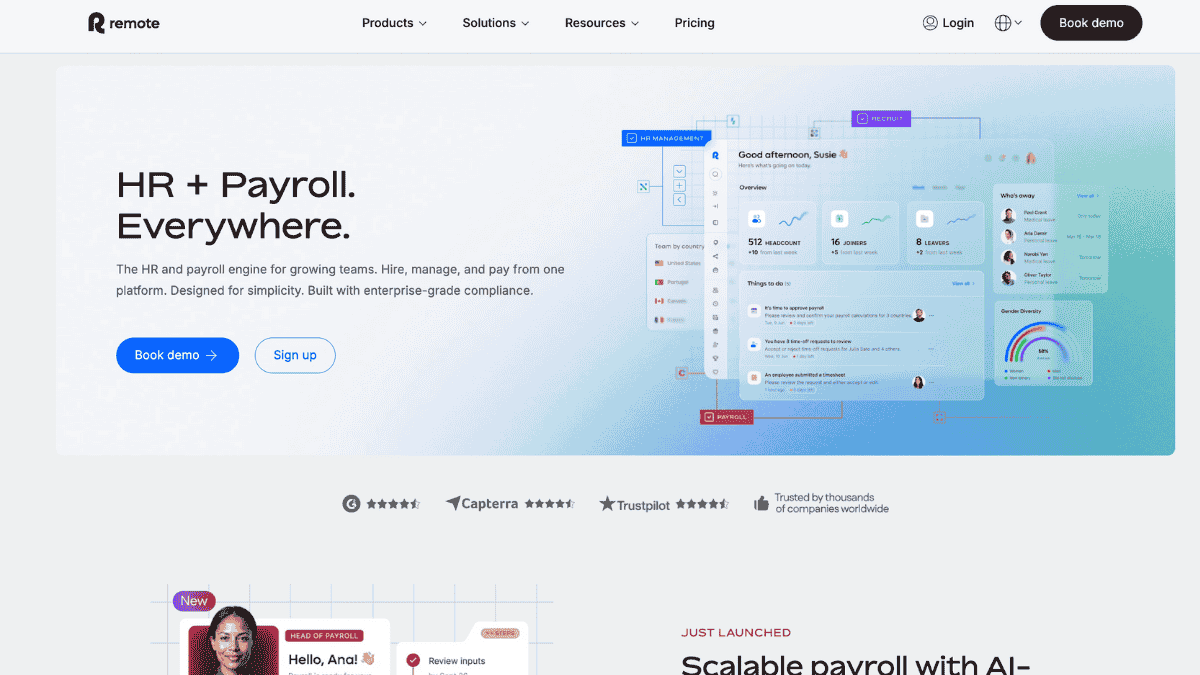
Compliance-First Global EOR Built for Scaleups & Tech Teams
Remote is one of the “big three” global Employer of Record platforms, built for fast, compliant international hiring through owned legal entities in 150+ countries. Founded in 2019 in Lisbon, Portugal, Remote pairs a clean self-service product with strong equity and stock-option administration, making it a popular choice for scaleups, international tech companies, and US-based businesses with straightforward global hiring needs. This Remote review covers pricing, scores, services, integrations, and our final buyer recommendation.
Remote was founded in 2019 in Lisbon, Portugal, by Job van der Voort and Marcelo Lebre. The company has scaled rapidly to become one of the “big three” global Employer of Record platforms alongside Deel and Papaya Global, with a strong reputation for product quality and compliance discipline.
Remote operates primarily through directly-owned legal entities, providing EOR, contractor management, payroll, HRIS, and equity administration in 150+ countries. The platform is particularly well known for its flat, predictable pricing model, its modern self-service interface, and its strength in administering global equity and stock options for scaleup teams.
Remote’s positioning is as a compliance-first, product-led EOR rather than a full add-on ecosystem. Its strength is reliable execution on standard global hiring scenarios, with the cleanest user experience of any major EOR and especially strong support for tech-first companies that pay employees substantially in equity.
As part of our independent EOR reviews at Employsome, we evaluate Remote using our data-driven editorial scoring framework, which combines global EOR capabilities with verified country-level execution to reflect real-world compliance and delivery quality. This Remote review is built on procurement-stage testing, direct vendor evaluation, verified G2 and Capterra cross-reference, and benchmarking against 130+ Employer of Record providers in our database.
In this expert Remote EOR review, we analyse Remote’s pricing, contract terms, platform features, compliance reliability, and on-the-ground operations to assess how it performs against other leading Employer of Record providers like Deel, Remote, and Rippling. Remote sits in our top tier for owned-entity coverage and platform technology, with one area to address during procurement: the flat-fee pricing model can be expensive for lower-cost markets.
Our complete Remote review covers the full evaluation: scoring breakdown across six categories, Remote services overview, country coverage analysis across 150+ markets, transparent Remote pricing with watch-out fees, balanced pros and cons, and a final buyer recommendation. We also benchmark Remote against the top EOR platforms in our Best Employer of Record comparison, where you can review country-specific scores, pricing differences, and provider rankings across global markets.
A market-leading EOR built for scale, with premium pricing to match
Our Remote review confirms what most procurement teams already suspect: Remote is one of the strongest all-round Employer of Record providers on the market. The platform is industry-leading, with deep automation across onboarding, payroll, compliance, and equipment management, and 40+ native integrations that let it function as a standalone global HRIS. Remote’s 4.6 aggregate score reflects exceptional all-round performance across global coverage, platform technology, payment terms, and customer experience. Remote stands out for its clean self-service interface, compliance-first approach, and strong equity and stock-option administration. EOR coverage spans 150+ countries with owned legal entities in most major hiring markets.
The one area scoring slightly lower is Pricing (4.0), reflecting Remote’s flat $599 per employee per month structure that prioritises predictability over the lowest possible cost. For scaleups and tech-first companies that value compliance, ease of use, and global equity support, Remote is one of the strongest choices in the EOR market.

How Remote Scores: Our Data-Driven Analysis
Our 2026 Remote scoring is based on Employsome’s six-factor evaluation framework, combining direct vendor evaluation, verified user reviews, country-level execution checks, and procurement-stage testing. Each category in the Remote review is independently weighted and benchmarked against the EOR category average across 130+ Employer of Record providers we have evaluated.
Remote’s aggregate score of 4.5 out of 5 reflects real-world deployment performance across 28 sub-factors, weighted by procurement importance and benchmarked against 130+ EOR providers globally, with standout performance in global coverage (5.0), payment terms (4.5), customer support (4.5), and platform technology (4.5). The detailed breakdown below shows the headline score, the comparative percentile against benchmarked providers, and the analysis behind each category score in this Remote review.
Global EOR Score
Global Coverage & Services
Pricing & Transparency
Payment & Contract Terms
Customer Experience & Support
Platform & Integrations
Key Features & Services of Deel
Remote offers a comprehensive workforce solution covering Employer of Record (its core product), contractor management, global payroll, advanced HRIS (Remote HR), and standout services like Remote Talent marketplace and global equity administration. This breadth of Remote services consolidates global HR needs under a single vendor, reducing procurement complexity for companies scaling international teams.
For most buyers, Remote’s primary value sits in the EOR product backed by 100+ legal entities worldwide. The contractor management, global payroll, and US PEO offerings act as adjacent services that extend Remote’s utility as your team grows or your hiring needs diversify.
🌍 Global Employer of Record
Remote’s strongest service, with 100+ owned entities worldwide. Direct legal infrastructure rather than third-party partners.
📝 Contractor Management
Standard contractor management plus Agent of Record (AOR) services. Handles invoicing, tax documentation, and payments at scale.
🎯 Remote Talent Marketplace
Unusual for an EOR, Remote runs its own pre-vetted global talent marketplace. Lets you discover and hire international candidates without recruiters.
📦 Add-On Services
Equipment shipping, office rentals, immigration support, visa assistance. End-to-end partner for distributed teams.
⭐ Owned-Entity Network
Primary delivery via directly-owned legal entities in major hiring markets ensures compliance reliability.
Remote Country Coverage: Owned Entities vs Partner Network
How a provider builds its global presence makes a significant difference in employee experience, compliance reliability, and long-term cost. Remote operates primarily through its owned-entity infrastructure, directly establishing and managing its legal presence in most key countries rather than relying on third-party partners.
In practice, Remote may initially partner with a trusted local vendor to launch operations quickly in a new market. Once volume and complexity justify it, the company incorporates its own legal entity and migrates employees under that entity. The breakdown below summarises Remote’s verified legal entity details across 150+ countries where the company has direct legal presence.
Owned-entity coverage with strong equity support as Remote’s real differentiator
Most EOR providers claiming 150+ country coverage actually operate through partner networks in the majority of their markets. Remote’s primary delivery via owned legal entities place it in the top tier for true infrastructure ownership. For companies with hiring concentrated in Europe and Asia-Pacific, this materially reduces vendor risk: contract enforcement, compliance accountability, and employee experience are handled by Remote directly rather than mediated through a third party.
Remote Pricing Overview
Remote pricing is straightforward: a flat per-employee monthly fee for EOR services, contractor management, and global payroll, with no setup fee and no minimum commitment. Annual Remote contracts attract discounts of typically 15-20%, while month-to-month plans cost slightly more. The Remote pricing comparison below shows headline rates plus the additional fees worth negotiating before signing.
Compared with other EOR pricing in the market, Remote sits in the competitive mid-tier: more affordable than enterprise-first providers like Velocity Global or Atlas, broadly comparable with Remote and Remote on base rates, and slightly more flexible than incumbents on contract terms. The Remote cost watch-outs below detail the additional fees that buyers should factor into total cost of ownership.
Predictable flat-fee pricing, with one trade-off to plan for
Remote’s flat $599 per employee per month is identical across most countries, making budgeting straightforward and predictable for finance teams. The trade-off is that this rate can feel expensive relative to local salaries in lower-cost markets, particularly for junior or administrative roles. Regional EOR providers with country-specific pricing may offer lower rates in those cases. If your hiring is concentrated in higher-cost markets or you value cost predictability over the cheapest possible rate, Remote’s pricing model is a strong fit.
Who Is Remote Best For?
Remote is the right fit for a wide range of EOR buyers, particularly scaleups, growing teams, and US-based companies expanding internationally. The buyer-fit breakdown below maps where Remote excels across seven procurement dimensions, based on our independent Remote review rather than marketing positioning. Use this to quickly confirm Remote is the right match for your hiring profile, company stage, and operational priorities.
Remote Pros & Cons
Every EOR provider has trade-offs, and this Remote review aims to surface them honestly. The balanced view below summarises Remote’s four most significant strengths against four areas worth scrutinising during procurement. Each item reflects our direct evaluation experience and verified user feedback rather than vendor marketing.
Remote Integration Deep Dive
Remote’s integration ecosystem is where its product-led positioning shows most clearly. Around 20 native integrations cover the most-used categories for global HR teams: HRIS and ATS platforms as upstream sources of truth, ERP and accounting systems as downstream financial sinks, plus a public REST API, Slack notifications, Zapier automation, and a device management partnership with Fleet. The breadth is more focused than Deel’s 40+ catalog, but the integrations Remote does ship tend to be well-documented and reliably implemented. The most notable gap worth flagging upfront: there is no native expense management sync, so expense data lives in Remote’s dashboard or requires a Zapier workaround. We break down each category and its sync direction below.
Remote offers around 20 native integrations across HRIS, ATS, ERP, and productivity tools, plus a public REST API and Zapier connector. Coverage is more focused than Deel’s, but the integrations that exist are well-documented and reliably implemented. Notable gap: no native expense management integration.
Remote Platform Deep Dive: Onboarding, Payroll, and Workflows
Beyond pricing and scores, the real Remote customer experience comes down to how the platform actually works day to day. Remote’s workflow follows a standardised three-stage flow from account setup through onboarding and into ongoing payroll. The interface is widely praised for being clean and intuitive, the steps are well-documented, and the workflows are predictable, which is a major part of why Remote scores so well on platform and customer experience. Below, we walk through each phase with screenshots and a breakdown of what to expect in practice, including how the EOR and contractor tracks differ and where the trade-offs sit compared to Deel and other competitors.
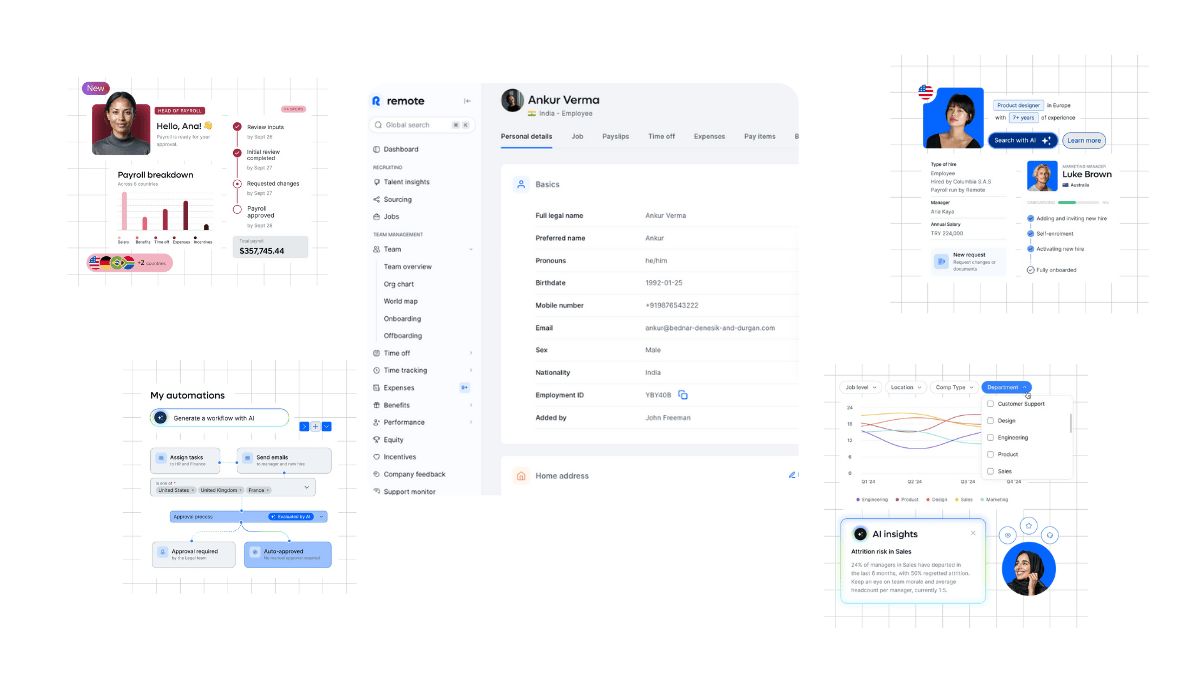
Sign Up & First Hire with Remote
Remote describes its onboarding process as a “streamlined customer process” emphasising self-service. In practice, account creation begins with the sign-up page where you enter name, company email, and password. After accepting terms of service, you receive a confirmation email establishing you as the official company account owner.
Platform access is then granted, but with limitations until additional compliance and KYC/KYB processes are completed. These checks are usually only required for EOR hiring, with a lighter KYC/KYB process for contractor-only accounts.
Although Remote offers a self-sign-up option, it is not prominently displayed on the homepage. Unlike Deel or Multiplier, where users are encouraged to set up their own account in a few clicks, Remote places more emphasis on joining a sales call before signing up. This is a strategic design choice: Remote’s core business is heavily focused on EOR, where margins are significantly higher than contractor management (often up to 10× higher per worker).
Contractor & Employee Onboarding
Once the company account is approved, you can add your first hires. The onboarding workflow is divided into two separate tracks for EOR employees and contractors. While both share some steps, the EOR process has more steps and is more compliance-driven.
During the new hire request, the employer adds basic information and sends an invite link to the new hire. The employee or contractor logs in and adds personal details, and for EOR uploads ID and tax documentation. Remote then verifies eligibility and runs employment verification checks in line with local labour laws, enrolling the person into benefits programs where applicable.
The next step is automated contract generation, producing a localised employment contract or contractor agreement. Depending on the country, you can define working hours, leave policies, benefits, notice periods, and area of work, all in line with local laws. Employers can request custom clauses and non-standard benefits, but Remote’s legal team reviews them before any contract is sent.
Contractor agreements are simpler: three contract types are available Fixed Rate, Milestone-based, or Pay-as-you-go with one-off or recurring payments.
Payments, Payroll & Invoicing
Remote consolidates all EOR and contractor transactions into a single monthly invoice, making reconciliation across multiple countries easier. Invoices are broken down by employee or contractor, employer taxes and contributions, and service fees. They are available in PDF or CSV and can be paid by bank transfer or ACH. For multi-currency invoices, Remote provides a wallet function to allocate funds per currency.
Contractor payments are more flexible than EOR payroll since fixed payroll cycles do not apply. Payments must be approved, and once Remote receives funds, the payment is transferred to the contractor and converted into the contractor’s currency of choice. This process typically takes 2-5 days depending on country and payment method.
EOR payroll is more involved. Payroll for most countries is processed monthly. Remote calculates salaries, benefits, taxes, and employer burdens, then issues an itemised invoice. Once paid, Remote distributes salaries in local currencies and pays employer burdens. For some countries, Remote uses actual employer burden numbers so no invoice adjustments are needed. For others where invoices must be issued before actuals are known, Remote sends an additional reconciliation invoice covering changes made after mid-month cutoff, including new hires, bonuses, and prorated adjustments.
Remote Contract Terms
Remote’s contract terms are similar to other EOR providers, defining the responsibilities of Remote and the client. The structure is standardised across most countries, prioritising compliance reliability over contractual flexibility.
Standard Service Agreement
- • Comply with local labour, tax, and employment laws
- • Manage onboarding and offboarding
- • Process payroll, tax remittances, and statutory deductions
- • Administer benefits programs
- • Handle termination on behalf of the client
- • Provide accurate information for employees and contractors
- • Approve and fund payroll on time
- • Pay Remote for all related costs and fees
- • Honour Net 14 invoice payment terms
Liability & IP Terms
Remote’s liability cap per contract year is limited to the total annual service fees paid for that year. For data or IP breaches, the cap is raised to 5× annual service fees. This is a standard structure for EOR providers and protects both parties from disproportionate claims.
All intellectual property created under EOR agreements is transferred to the client through the employment contract. Confidentiality clauses are included in every contract. For tech-first companies where IP ownership is critical, this is a well-protected provision.
Term & Termination
Remote’s contracts provide limited flexibility as they typically run on a 12-month term. If you want to test the market or release an employee earlier, you may still need to continue paying service fees for the duration of the term.
Contracts automatically renew for additional 12-month periods unless terminated with notice. In case of breach by either party, insolvency, or unpaid fees, you or Remote can terminate with 30 days notice or immediately.
| Clause | Key Points |
|---|---|
| Billing Frequency | Monthly (per active employee or contractor) |
| Minimum Term | 12 months (auto-renewal) |
| Termination Notice | 30 days standard |
| Liability Cap | Annual service fees (5× for data/IP breaches) |
| Late Payment Penalty | 0.1% per day |
| Refund Processing Time | Up to 60 days post-termination |
| Data Governance | GDPR, CCPA, Data Privacy Framework compliant |
Remote Customer Reviews
Customer feedback for Remote is generally strong across the major review platforms. Users consistently praise the usability of the platform, the reliability of payroll across countries, and the quality of the onboarding experience. Critique tends to cluster around slower support responses for complex cases, delays during terminations, and benefits availability varying by country. Below we break down ratings across the three platforms that matter most for an EOR evaluation: Trustpilot and G2 for customer reviews on day-to-day product and support quality, plus Glassdoor for an employee-side view that often acts as a leading indicator of internal operational health and future support quality.
Customer feedback for Remote is strong across the major external review platforms. Trustpilot and G2 reviewers highlight onboarding ease, platform navigation, and reliable payroll. Critique mostly centres on slower support responses for complex cases and delays during terminations.
The Glassdoor score (employee, not customer) tells a different story: 3.4 / 5 with reports of operational growing pains and internal organisational pressure. While this does not directly translate into customer dissatisfaction today, it is worth monitoring as a leading indicator of support quality going forward.
Is Remote a Good EOR in 2026?
Based on this independent Remote review, Remote is one of the strongest all-round Employer of Record providers in our 2026 analysis and an excellent choice for startups, scaleups, and tech-first companies expanding internationally. Remote stands out as a strong, reliable, and easy-to-use global employment platform with industry-leading equity and stock-option administration, a clean self-service interface, and a flat-fee pricing model designed for predictability.
Our Remote review scored the provider 4.6 out of 5 across 28 sub-factors, placing Remote in the top 5% of 130+ Employer of Record providers we have evaluated. Remote scored Excellent (5.0) in Global Coverage and Platform & Integrations, Very Good (4.5) in Payment Terms and Customer Support, and Good (4.0) in Pricing. The one area scoring slightly lower is Pricing (4.0 Good), reflecting Remote’s flat-fee pricing model. This is a well-understood trade-off for the predictability the model provides. Remote is not perfect for every scenario: complex immigration cases, highly bespoke contracts, and deep customisation requirements can feel rigid. Remote also offers fewer add-on services than Deel or Papaya, and benefits offerings vary by country. While customer reviews are very positive, employee reviews on Glassdoor suggest some operational strain that may surface in slower support response times.
- Startups and scaleups with equity-heavy comp
- Tech-first companies expanding internationally
- Teams that value compliance and clean UX
- Companies wanting predictable flat-fee pricing
- Plan for 12-month minimum term with auto-renewal
- Confirm whether credit check waives deposit
- Verify benefits package coverage by country
- Account for support response times in complex cases
A predictable, compliance-first global Employer of Record with industry-leading equity support and a clean self-service platform. Excellent for startups, scaleups, and tech-first companies that value reliability and ease of use over heavy customisation. Flat-fee pricing prioritises predictability over the lowest possible rate, so confirm market fit if you hire concentrated in lower-cost countries.
Frequently Asked Questions about Remote
Remote is a global Employer of Record (EOR) platform founded in 2019 in Lisbon, Portugal. It helps companies hire international employees and contractors without setting up local entities. Remote handles payroll, taxes, benefits, compliance, and localised employment contracts through its directly-owned legal entities in major hiring markets. The platform is widely recognised as one of the “big three” EOR providers alongside Deel and Papaya Global, with particular strength in equity and stock-option administration for scaleups and tech-first teams.
Remote uses a flat-fee pricing model identical across most countries:
- EOR: $599 per employee per month (flat rate)
- Contractor Management: Around $29 per contractor per month
- Global Payroll: Around $50 per employee per month for companies with their own local entities
All fees exclude VAT, GST, and withholding taxes (client reimburses applicable taxes). FX conversion costs and payment method fees are paid by the client. The flat rate is designed for budget predictability, although it can be expensive relative to local salaries in some lower-cost markets.
Generally, no. Remote does not require a security deposit if the client passes a credit check. This is a notable differentiator versus most other EORs, which require 1 to 3 months of gross salary as a deposit. If the credit check fails, Remote may request a deposit before onboarding. Any deposits are refunded approximately 50 days after final invoices are cleared.
Yes. Remote uses a 12-month minimum term for EOR services, with automatic renewal for additional 12-month periods. If you want to release an employee earlier, you may still need to continue paying service fees for the duration of the term. Contractor services are more flexible and do not require the same long-term commitment.
Onboarding speed depends on the type of hire:
- Contractors: More or less instant once the invite is accepted
- EOR employees: Typically 7 to 14 days, depending on the country and the complexity of local compliance checks
Remote’s onboarding speed for EOR is generally faster than Oyster, Multiplier, or G-P, and similar to Deel.
You (the client) keep the IP when Remote employs your team through EOR. All intellectual property created under EOR agreements is transferred to the client through the employment contract. Confidentiality clauses are included in every contract. Remote’s liability cap is the total annual service fees paid for that year, with a 5× cap specifically for data or IP breaches.
Yes, and this is one of Remote’s standout strengths. Remote provides global equity and stock-option administration, helping you issue and administer equity grants across multiple countries. Cross-border equity is notoriously complex with vesting, tax, and reporting rules varying by jurisdiction. For scaleups and tech-first companies that pay employees substantially in equity, this is often a material reason to choose Remote over other EORs.
Compare Remote with other top EOR providers




Courtney Pocock is a Copywriter at Employsome with 15+ years of experience writing for the HR, corporate, and financial sectors. She has a strong interest in global business expansion and Employer of Record / PEO topics, focusing on news that matters to business owners and decision-makers. Courtney covers industry updates, regulatory changes, and practical guides to help leaders navigate international hiring with confidence. Connect with Courtney on LinkedIn.
Our content is created for informational purposes only and is not intended to provide any legal, tax, accounting, or financial advice. Please obtain separate advice from industry-specific professionals who may better understand your business’s needs. Read our Editorial Guidelines for further information on how our content is created.